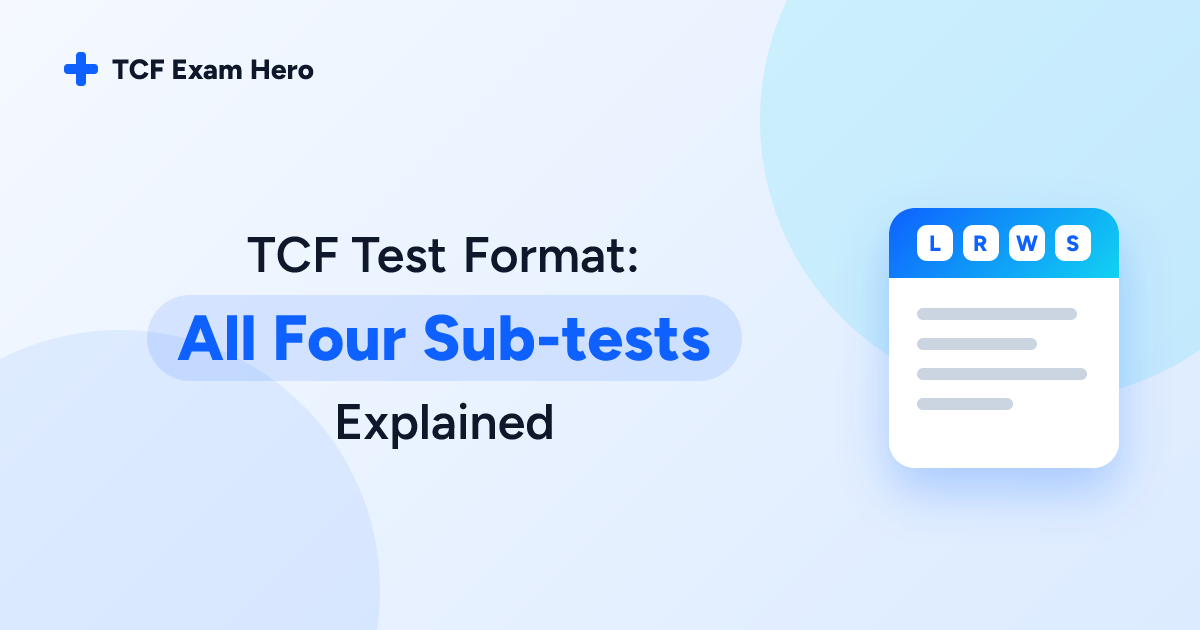
The TCF (Occupational English Test) has four sub-tests: Listening (about 40 minutes, 42 questions), Reading (60 minutes, 42 questions), Writing (45 minutes, one letter) and Speaking (about 20 minutes, two role-plays). Listening and Reading are the same for everyone. Writing and Speaking are set for your own profession. Each sub-test is scored from 0 to 500 with a letter grade, and most healthcare regulators ask for Grade B (350) in each one.
TCF at a glance
| Sub-test | Time | Content | Same for all professions? |
|---|---|---|---|
| Listening | About 40 minutes | 42 questions across Parts A, B and C | Yes |
| Reading | 60 minutes (Part A 15, Parts B and C 45) | 42 questions across Parts A, B and C | Yes |
| Writing | 45 minutes (5 reading, 40 writing) | One letter, usually a referral, written from case notes | No, profession-specific |
| Speaking | About 20 minutes | Warm-up (not assessed) and two role-plays | No, profession-specific |
Who is TCF for?
TCF is an English test built for healthcare professionals who want to register and work where English is the language of practice. It is available for twelve professions: dentistry, dietetics, medicine, nursing, occupational therapy, optometry, pharmacy, physiotherapy, podiatry, radiography, speech pathology and veterinary science. Instead of general academic topics, every task is drawn from healthcare settings: consultations, case notes, referral letters, workplace policies and clinical research.
TCF Listening: three parts, 42 questions
You hear each recording once. The sub-test runs to about 40 minutes and ends with a short window to check your answers.
- Part A (24 questions): two recorded consultations between a health professional and a patient. You complete the practitioner's notes with words you hear. Read the Part A guide.
- Part B (6 questions): six short extracts from the healthcare workplace, such as a handover or a team briefing, each with one three-option multiple-choice question. Read the Part B guide.
- Part C (12 questions): two longer recordings, a presentation and an interview, each with six multiple-choice questions. Read the Part C guide.
TCF Reading: three parts, 42 questions
Part A is timed on its own and collected before Parts B and C begin.
- Part A (20 questions, 15 minutes): four short texts on one topic. You match information, answer short questions and complete sentences, fast. Spelling counts. Read the Part A guide.
- Part B (6 questions): six short workplace texts, such as a policy, a memo or a set of guidelines, each with one three-option question. Read the Part B guide.
- Part C (16 questions): two longer texts on healthcare topics, each with eight four-option questions that test detail, opinion and the meaning of words in context. Read the Part C guide.
Parts B and C share a single 45-minute block, so you choose how to split it.
TCF Writing: one letter from case notes
You get 5 minutes to read the case notes, during which you cannot write your answer, then 40 minutes to write. The task is usually a referral letter, though it can also be a transfer or discharge letter, or a letter to a patient or carer. Your letter is assessed against six criteria: Purpose, Content, Conciseness and Clarity, Genre and Style, Organisation and Layout, and Language. Read the Writing guide.
TCF Speaking: two role-plays
After a short warm-up about your professional background, which is not assessed, you complete two role-plays. For each one you get 3 minutes to prepare with a role-play card and about 5 minutes to talk. You play yourself, and the interlocutor plays a patient, a relative or a carer. The recording is assessed against nine criteria: four linguistic criteria and five clinical communication criteria. Read the Speaking guide.
How TCF is scored
Each sub-test gets its own score from 0 to 500 in steps of 10, with a grade from A to E. There is no overall score. Grade B, 350 to 440, is the standard most regulators set. See the full grade table and what boards ask for.
How to prepare for the TCF format
- Take one full sample test under real timing to find your weakest sub-test before you plan anything.
- Drill the weakest part on its own, one part at a time, until the method is automatic.
- Get criteria-based feedback on Writing and Speaking, because those two are marked against descriptors, not an answer key.
- Finish with timed full mocks in the last two weeks so the 40, 60 and 45 minute blocks feel normal.
Exam Hero's free account includes one full-length TCF mock test and one free question in every part of the question bank.