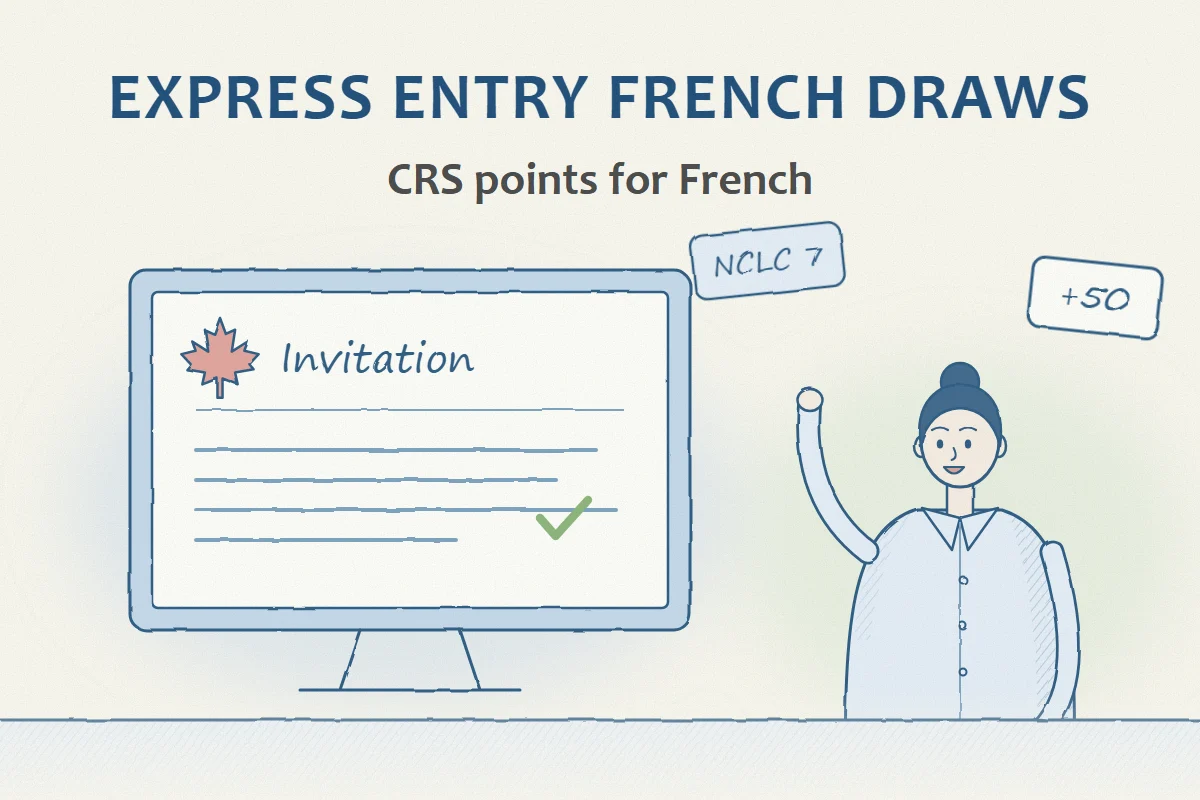
French-language Express Entry draws invite candidates who have NCLC 7 or higher in all four French abilities, and their cut-offs are far lower than general draws: between 382 and 435 CRS points in 2026, against 507 to 523 for Canadian Experience Class draws. The same NCLC 7 in French also adds up to 50 CRS points to your score, plus up to 24 points for French as a second official language.
- French draws need NCLC 7 or higher in all four abilities, on the TCF Canada or the TEF Canada.
- 2026 French draws: 12 rounds, 60,500 invitations, cut-offs from 382 to 435.
- Additional points: 50 with CLB 5+ in English, 25 with CLB 4 or lower or no English test.
- French as a second official language adds up to 24 points (22 with a spouse).
- Your weakest French test decides: one ability at NCLC 6 means no draw and no bonus.
What is an Express Entry French draw?
Express Entry ranks candidates with the Comprehensive Ranking System (CRS) and invites the highest scores to apply for permanent residence. Since 2023, IRCC also runs category-based rounds, and French-language proficiency is one of the categories. In a French round, only candidates with French test results at NCLC 7 or higher in all four abilities can be invited, so they compete with each other instead of with the whole pool.
To be eligible you also need an Express Entry profile under one of its three programs: the Federal Skilled Worker Program, the Canadian Experience Class or the Federal Skilled Trades Program. Your occupation doesn't matter in a French round.
What were the CRS cut-offs in 2026 French draws?
These are IRCC's figures for every French-language round in 2026, up to October 27.
| Date | Invitations | CRS cut-off |
|---|---|---|
| October 27, 2026 | 5,000 | 407 |
| October 16, 2026 | 5,000 | 435 |
| August 19, 2026 | 5,000 | 382 |
| August 6, 2026 | 5,000 | 391 |
| July 22, 2026 | 5,000 | 399 |
| July 9, 2026 | 5,000 | 420 |
| May 28, 2026 | 4,500 | 409 |
| April 29, 2026 | 4,000 | 400 |
| April 15, 2026 | 4,000 | 419 |
| March 18, 2026 | 4,000 | 393 |
| March 4, 2026 | 5,500 | 397 |
| February 6, 2026 | 8,500 | 400 |
Over the same period, Canadian Experience Class draws closed between 507 and 523, and Provincial Nominee Program draws between 697 and 805 (those scores include the 600 nomination points). A candidate at 420 has little chance in a general round but has been invited in most French rounds this year.
Cut-offs move with the size of the round and the pool, so treat them as a guide, not a promise. When several candidates share the cut-off score, IRCC invites those who created their profile first (the tie-breaking rule).
How many CRS points does French give?
French can add points in two places. The first is a bonus for NCLC 7 or higher in all four French abilities:
| Your French | Your English | Additional points |
|---|---|---|
| NCLC 7+ in all four | CLB 5+ in all four | 50 |
| NCLC 7+ in all four | CLB 4 or lower, or no English test | 25 |
| Below NCLC 7 in any ability | Any | 0 |
The second is the language score itself. One language is your first official language and the other your second; put your stronger language first, since it earns far more points. For the second official language, CRS gives points per ability:
| NCLC in each ability | Points per ability |
|---|---|
| 9 or more | 6 |
| 7 or 8 | 3 |
| 5 or 6 | 1 |
| 4 or less | 0 |
The second-language total is capped at 24 points without a spouse and 22 with one. If French is your first official language, it is scored on the full first-language table instead: 17 points per ability at NCLC 7 and up to 34 at NCLC 10 (a little less with a spouse).
How much does NCLC 7 in French add to a real profile?
Two single candidates, comparing the language points only:
| Profile | Language points | French bonus | Difference |
|---|---|---|---|
| English CLB 9 in all four, no French test | 124 | 0 | – |
| Same, plus French NCLC 7 in all four | 124 + 12 | 50 | +62 |
| Same, plus French NCLC 9 in all four | 124 + 24 | 50 | +74 |
| French NCLC 7 in all four, no English test | 68 | 25 | – |
| Same, plus English CLB 5 in all four | 68 + 4 | 50 | +29 |
For an English speaker, NCLC 7 in French is worth about 60 points and access to the French draws. For a French speaker, an English test at CLB 5 is worth 29 more points, because it doubles the bonus.
Why does your weakest French test decide?
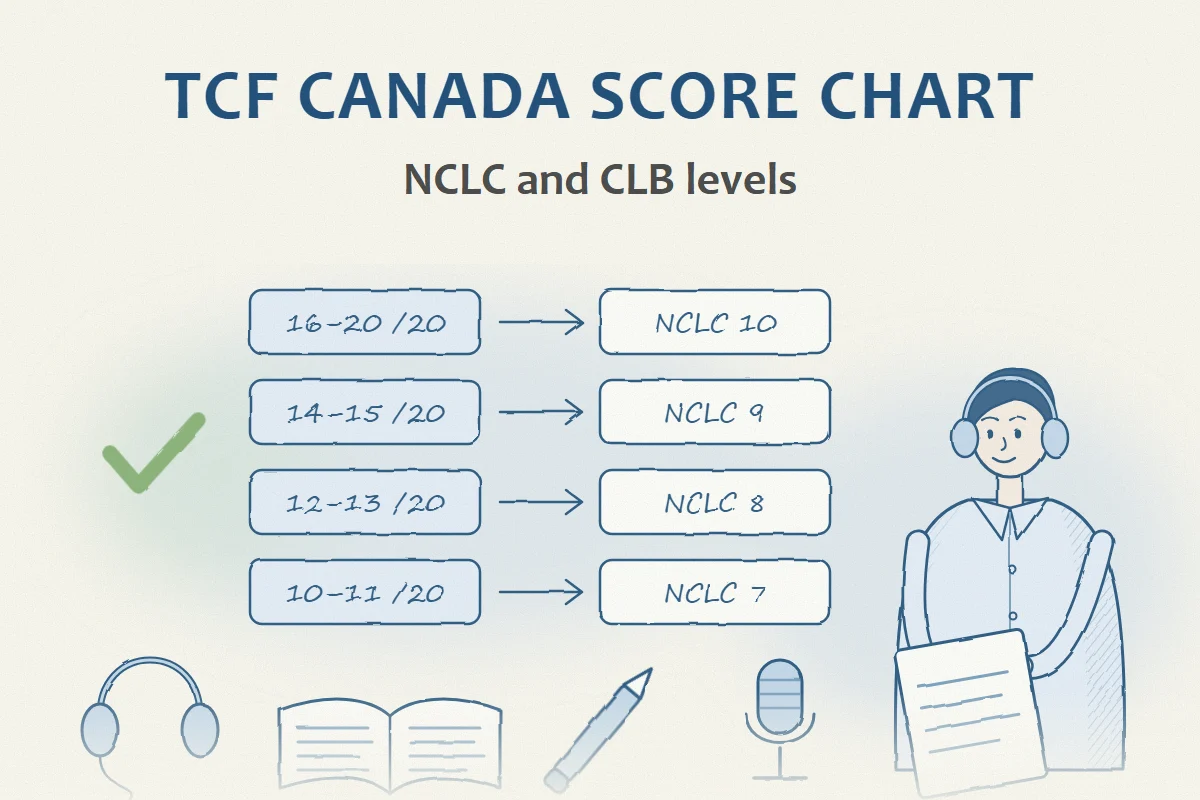
Both the draws and the bonus ask for NCLC 7 in all four abilities, and IRCC reads each test on its own. A candidate with NCLC 9 in Listening, Reading and Writing but NCLC 6 in Speaking gets no bonus and can't be invited in a French round. On the TCF Canada, NCLC 7 starts at 458 in Listening, 453 in Reading and 10 out of 20 in Writing and Speaking: see the full TCF Canada score chart.
That's why the best use of your preparation time is usually your lowest test, not your favourite one.
Which French test should you take for Express Entry?
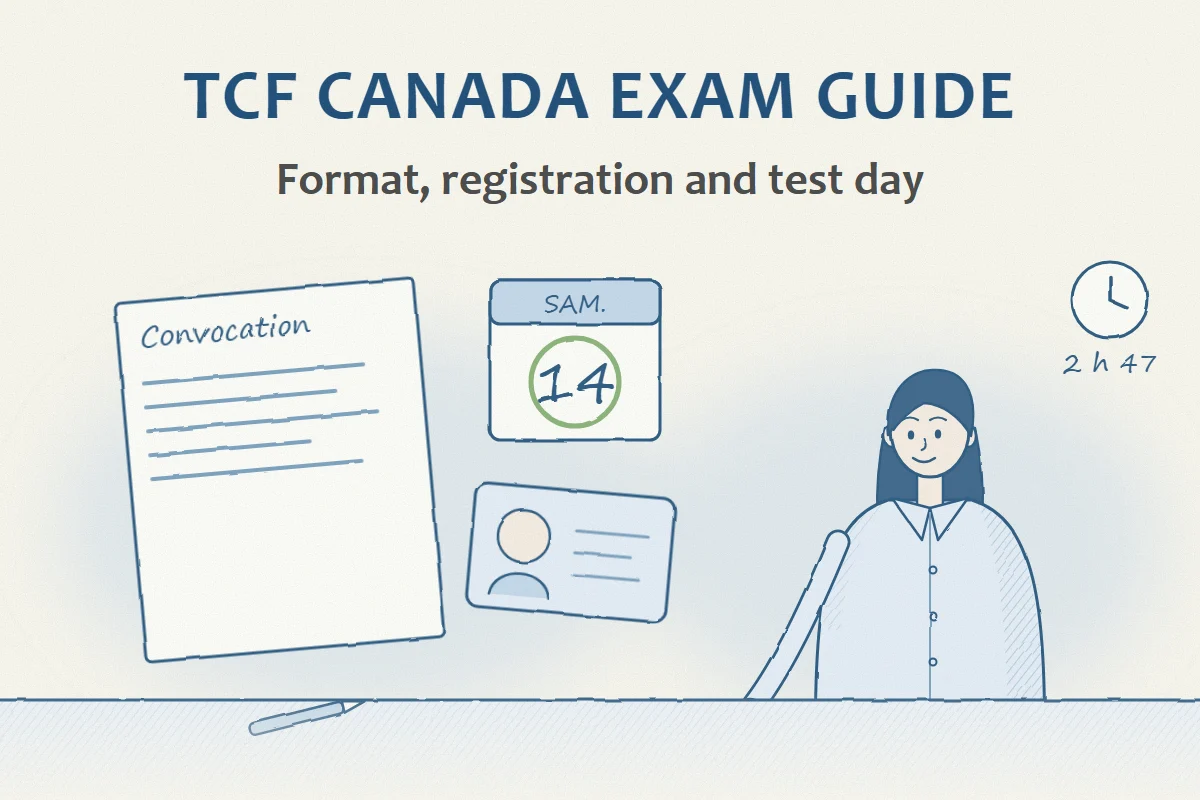
IRCC accepts the TCF Canada and the TEF Canada, and both convert to the same NCLC levels. Results must be less than two years old when you create your profile and when you apply for permanent residence, so time the test with your application. To choose between them, read TCF Canada vs TEF Canada; for registration, fees and test day, read the TCF Canada exam guide.
How do you reach NCLC 7 in all four?
- Take a full TCF Canada mock test to get an estimated NCLC in each test.
- Find the test furthest from NCLC 7 and put most of your time there.
- Practise by level in the question bank, and each Writing and Speaking task with AI feedback.
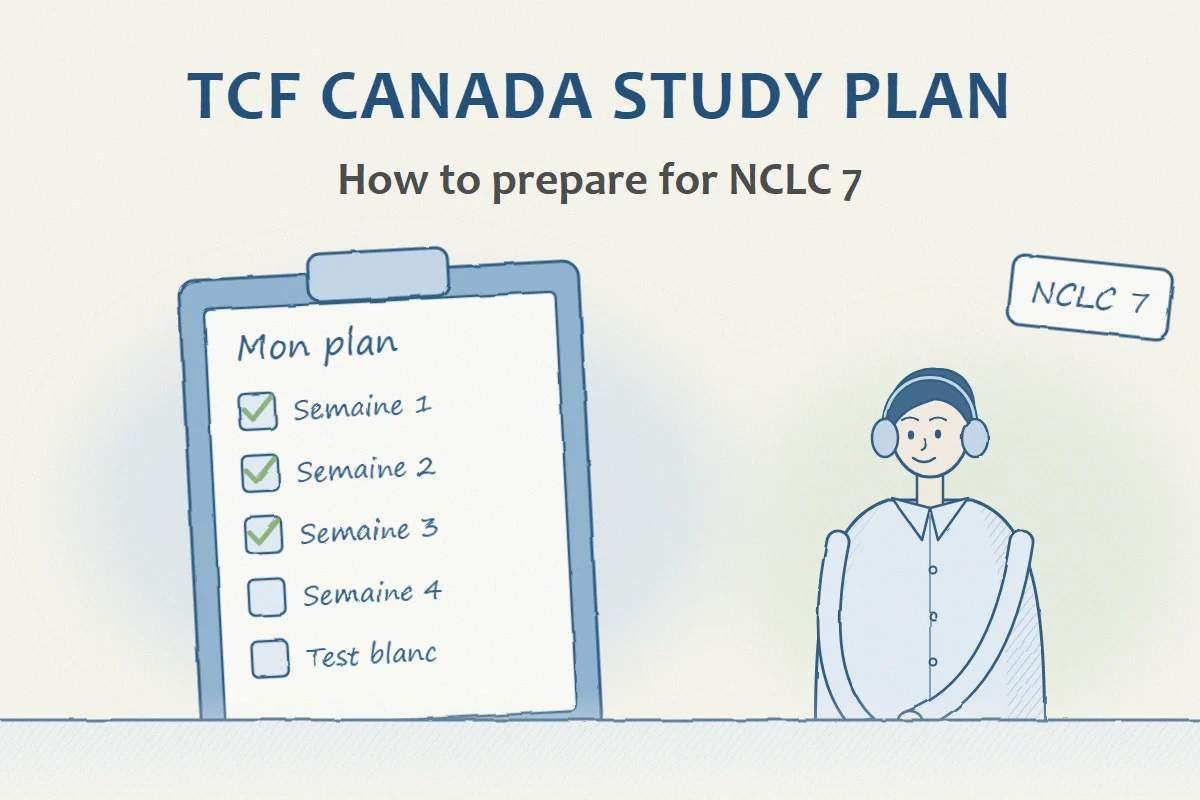
- Follow a plan: the TCF Canada study plan has 8-week and 12-week versions.
These rules change, so check IRCC's current pages before you book or apply. Exam Hero is an independent preparation platform, not affiliated with FEI or IRCC, and its scores are estimates.