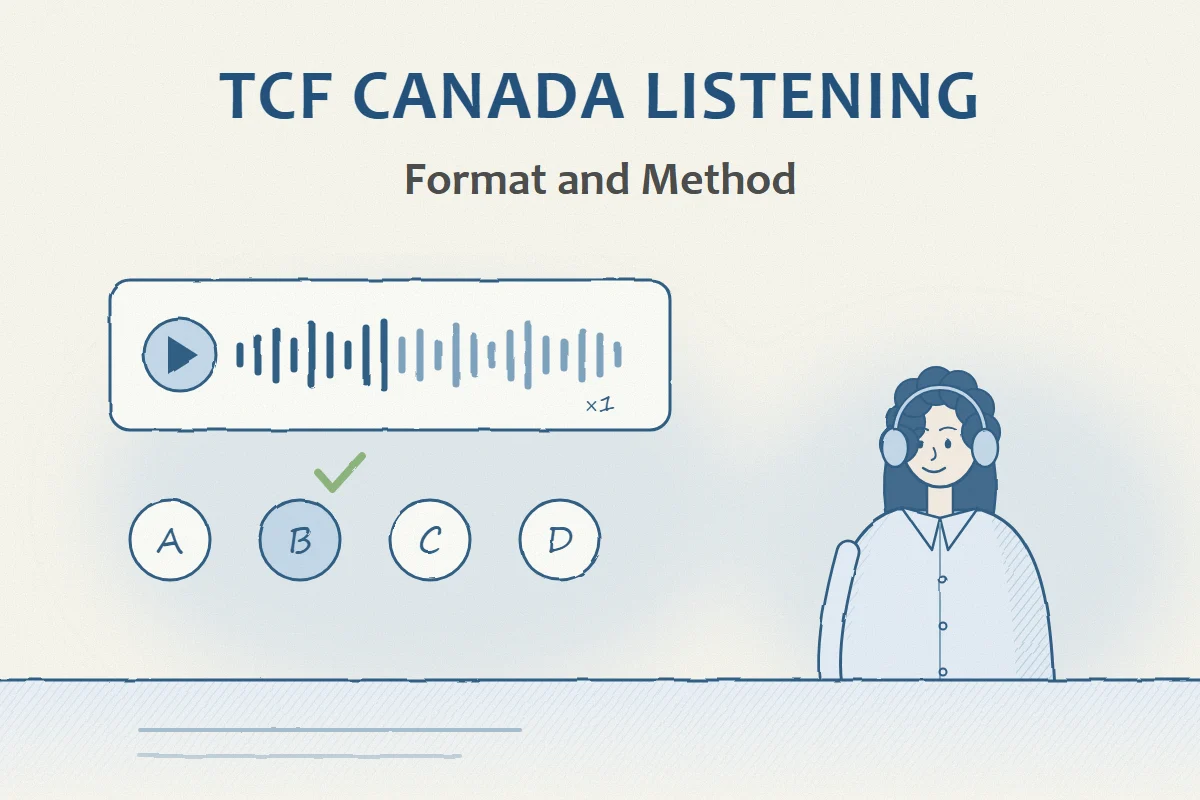
TCF Canada Listening (Compréhension orale, or CO) is 39 multiple-choice questions in 35 minutes. Each question has four options and one correct answer, the questions get harder from A1 up to C2, and each recording is played only once, with the question asked after it. You get a score from 100 to 699, which IRCC converts to an NCLC level.
- 39 questions, 35 minutes, four options each, one correct answer.
- Each recording plays once. The question comes after the recording.
- Questions run from easy (A1) to hard (C2).
- A wrong or blank answer scores 0, with no penalty.
- NCLC 7 starts at 458 in Listening.
What does the Listening test look like?
| Detail | What to expect |
|---|---|
| Questions | 39 |
| Time | 35 minutes |
| Format | Multiple choice, four options (A, B, C, D), exactly one correct |
| Order | Increasing difficulty, from A1 to C2 |
| Recordings | Played once; the question is asked after the recording |
| Wrong or blank answer | 0 points, no penalty |
| Score | 100 to 699 |
The early questions use short, everyday recordings: a message, an announcement, a simple exchange. Later ones are longer and more abstract, such as interviews and discussions where you have to follow an argument or pick out a speaker's opinion.
How is Listening scored?
Correct answers are weighted by difficulty and turned into a score from 100 to 699. France Éducation international (FEI), which runs the TCF, does not publish the weights or how many correct answers make a given score. Any practice score, ours included, is an estimate.
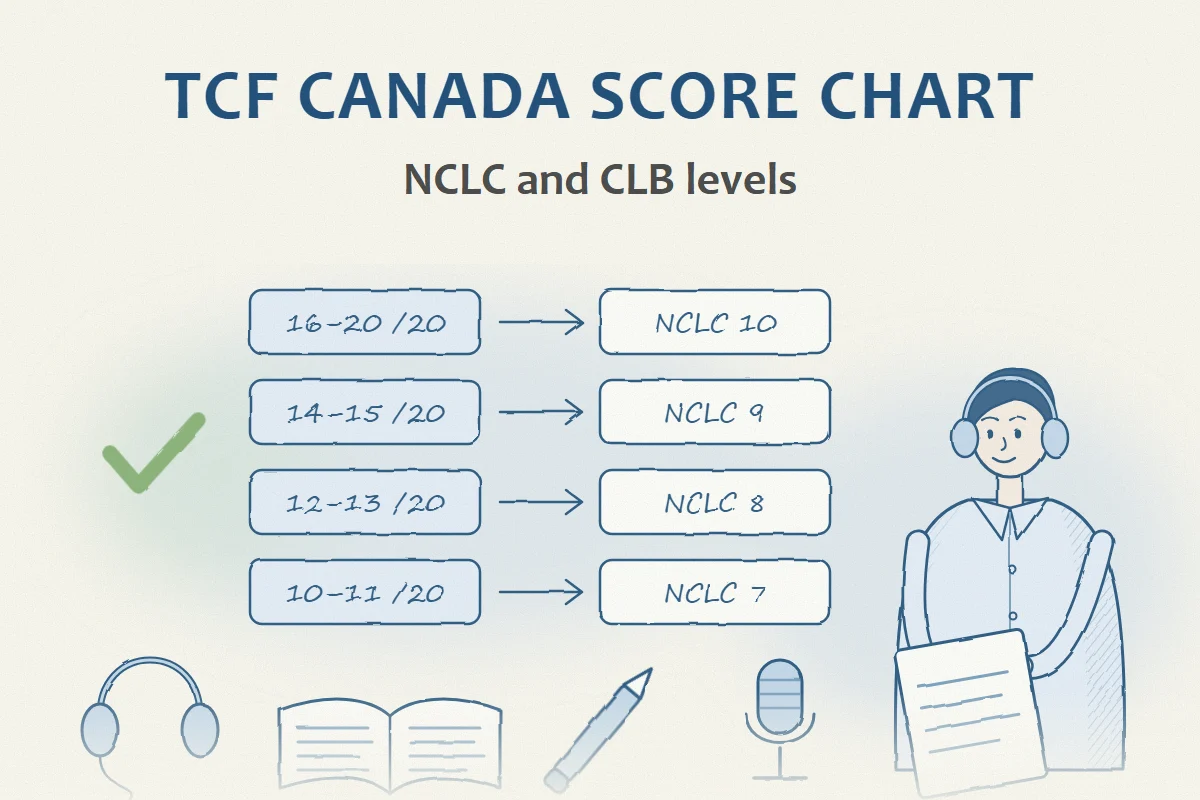
The score gives you a CEFR level, and IRCC converts it to an NCLC level with its own table for Listening:
| NCLC | Listening score |
|---|---|
| 10 and above | 549–699 |
| 9 | 523–548 |
| 8 | 503–522 |
| 7 | 458–502 |
| 6 | 398–457 |
| 5 | 369–397 |
| 4 | 331–368 |
The Reading cut-offs are different, so don't use this table for Reading. Check IRCC's website for the current table before you rely on it.
How should you answer each question?
- Use the silence before the recording. If the options are on screen or paper before you hear the audio, read them. They tell you what kind of detail matters: a time, a place, a reason, an opinion.
- Listen for the whole message, not one word. A wrong option often repeats a word you hear. The right one usually says the same idea in different words.
- Answer and move on. The recording won't come back. If you're unsure, choose the most likely option and focus on the next question.
- Never leave a blank. A blank and a wrong answer both score 0, so a guess can only help.
What mistakes cost the most marks?
- Losing time early. The first questions are the easiest marks on the paper. Stay calm and take them.
- Choosing the option with the word you heard. Check that the whole option matches what was said.
- Dwelling on a missed question. While you think about the last one, the next recording is playing.
- Practising with transcripts open. On test day you hear each recording once, so practise the same way.
How should you practise Listening?
Practise by CEFR level. Start at A1 and move up one level at a time. The first level where you get fewer than half the questions right is your working level, so spend most of your time there until you hold it, then move up. This builds the skill the test rewards: understanding speech you hear only once.
- Three short sessions of questions at your working level, recordings played once.
- One session with a set from the level above, to stretch.
- Every two or three weeks, a full timed Listening test to check your estimated NCLC.
Exam Hero's question bank has Listening sets at every level from A1 to C2, and the mock tests run all 39 questions under exam timing. Exam Hero is an independent preparation platform, not affiliated with FEI or IRCC.