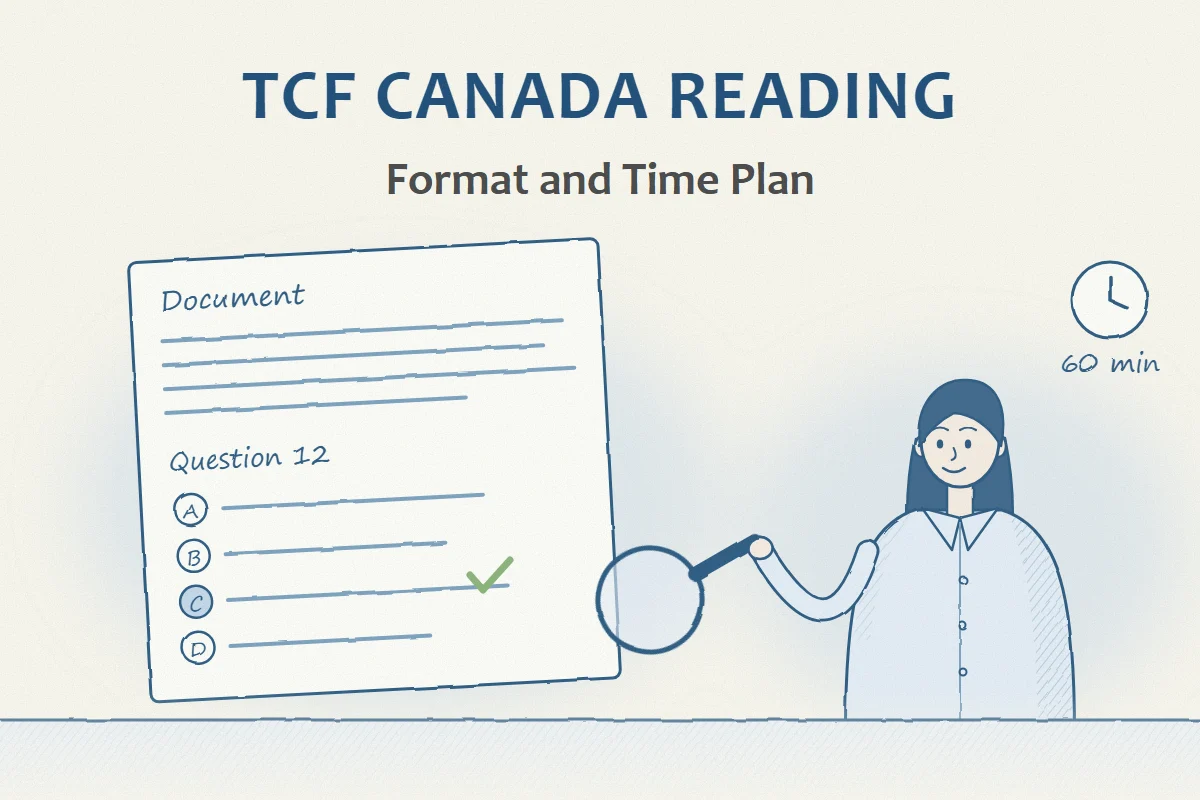
TCF Canada Reading (Compréhension écrite, or CE) is 39 multiple-choice questions in 60 minutes. Each question has four options and one correct answer, and the texts get harder from A1 up to C2. You get a score from 100 to 699, which IRCC converts to an NCLC level with a table of its own for Reading.
- 39 questions, 60 minutes, four options each, one correct answer.
- Texts run from short everyday notices (A1) to complex articles (C2).
- A wrong or blank answer scores 0, so answer everything.
- Save time on the early questions for the harder ones at the end.
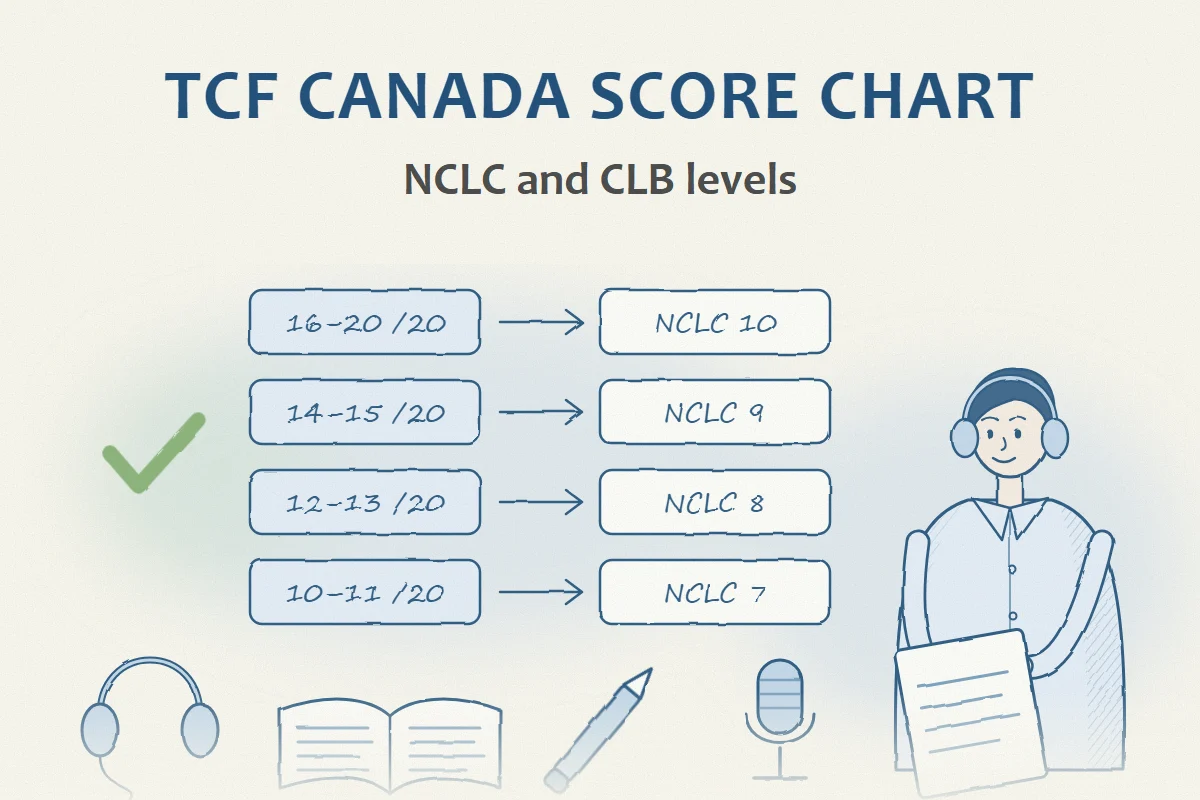
- NCLC 7 starts at 453 in Reading.
What does the Reading test look like?
| Detail | What to expect |
|---|---|
| Questions | 39 |
| Time | 60 minutes |
| Format | Multiple choice, four options (A, B, C, D), exactly one correct |
| Order | Increasing difficulty, from A1 to C2 |
| Wrong or blank answer | 0 points, no penalty |
| Score | 100 to 699 |
The first texts are short and practical: a sign, a message, an advertisement, a timetable. Further on come press articles, opinion pieces and more abstract texts where the question asks for the writer's point of view, the purpose of a passage or a conclusion you have to infer.
How should you plan your 60 minutes?
FEI doesn't set a time per question, only the 60 minutes for the whole test. On average that's about a minute and a half per question, but the questions aren't equal: the early ones take a few seconds and the last ones need careful reading. A simple plan:
| Questions | Level | Aim |
|---|---|---|
| The first third | A1–A2 | Answer quickly and bank time |
| The middle third | B1–B2 | Steady pace, read each text once with the question in mind |
| The last third | C1–C2 | Use the time you saved; read closely |
This is a working plan, not an official rule. Try it in a timed practice test and adjust it to your own pace.
How is Reading scored?
Correct answers are weighted by difficulty and turned into a score from 100 to 699. France Éducation international (FEI) doesn't publish the weights, so every practice score, including ours, is an estimate. IRCC converts the score to NCLC with this table:
| NCLC | Reading score |
|---|---|
| 10 and above | 549–699 |
| 9 | 524–548 |
| 8 | 499–523 |
| 7 | 453–498 |
| 6 | 406–452 |
| 5 | 375–405 |
| 4 | 342–374 |
These cut-offs differ from Listening at NCLC 4 to 9. Check IRCC's website for the current table.
How should you answer each question?
- Read the question first. Know what you're looking for before you read the text: a fact, the writer's opinion, the purpose of the text.
- Find the evidence. Locate the sentence that answers the question and compare each option with it.
- Watch for options that are partly true. A wrong option often uses words from the text but changes the meaning, exaggerates or adds something the text doesn't say.
- Don't get stuck. If a question takes too long, choose your best answer, note it and come back if time allows.
What mistakes cost the most marks?
- Spending too long on easy texts. Rereading an A2 notice three times takes time the C1 texts need.
- Answering from general knowledge. The answer is always in the text, not in what you think is true.
- Leaving blanks at the end. In the last minute, answer every remaining question.
- Translating word by word. Read for meaning. You don't need every word to understand the idea.
How should you practise Reading?
As with Listening, practise by CEFR level. Find the first level where you get fewer than half the questions right, work there until you hold it, then move up. Add one timed full Reading test every two or three weeks to practise the time plan.
Exam Hero's question bank has Reading sets at every level from A1 to C2, and the mock tests run all 39 questions in 60 minutes. Exam Hero is an independent preparation platform, not affiliated with FEI or IRCC.