
TCF Canada Writing
TCF Canada Writing Task 1 Template: A message
Greeting and context, the main point, the practical details, then a closing that asks for a reply. Four short blocks answer every point in the instructions, which is what the raters check first.
60 to 120 words · aim for about 90 · about 10 minutes
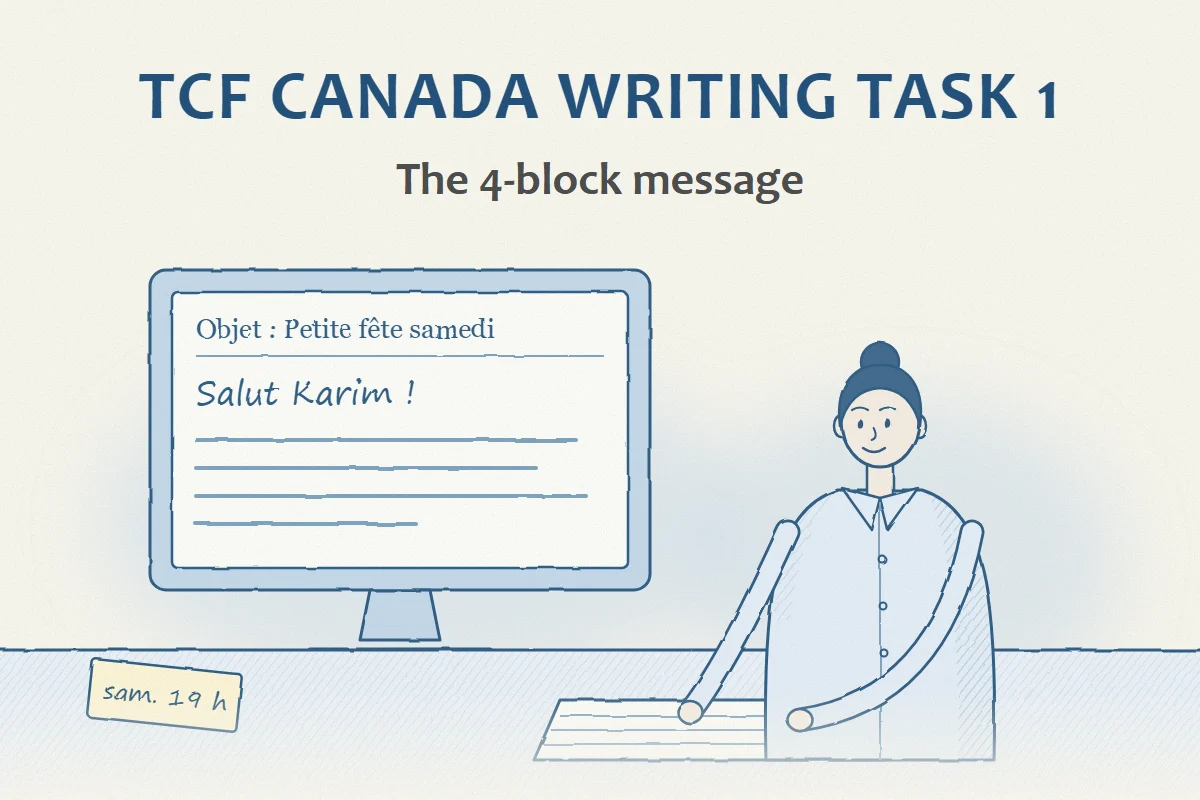
The 4-block message: remember it as
- Greeting and context
- The main point
- Practical details
- Closing
When to use it: Task 1 every time: an invitation, a reply, a request, news for a friend or a colleague. Pick the register before you write: tu and "Salut" for a friend, vous and "Bonjour Madame" for someone you don't know.
The template
Each part has one job and a word budget. Fill every blank from the subject in front of you: the raters reward an answer to this task, and a text learned by heart can be rated “A1 non atteint”.
- 1
Greeting and context
14 to 22 wordsGreet the reader and say why you are writing, in one or two sentences.
Starters, in French
- Salut blank, j’espère que tu vas bien !
- Bonjour Madame blank, je vous écris au sujet de blank.
- Comme tu le sais, blank.
Put in
- A greeting that fits the reader: "Salut Karim," or "Bonjour Madame Roy,"
- The reason for the message, with one concrete detail
Leave out
- Mixing tu and vous in the same message
- Copying the instructions as your first line
Earns:Fit to the situationCoherence and cohesion
- 2
The main point
25 to 42 wordsGive the news, the invitation or the request, with what, when and where.
Starters, in French
- Pour fêter ça, j’organise blank le blank à partir de blank.
- Je voudrais savoir s’il est possible de blank.
- Il y aura blank, et blank.
Put in
- Every fact the instructions ask for: a date, a time, a place
- One extra detail that makes it real, such as who will be there
Leave out
- A long story before the point
- Facts the instructions do not ask for, such as prices or sizes
Earns:Thematic developmentRange of vocabulary
- 3
Practical details
12 to 25 wordsExplain how: how to get there, what to bring, what happens next.
Starters, in French
- Pour venir, prends blank et descends à blank.
- N’oublie pas d’apporter blank.
- Si vous avez besoin de blank, vous pouvez blank.
Put in
- The last point of the instructions, answered in full
- A linking word that shows the order: pour venir, ensuite, sinon
Leave out
- Directions so detailed they eat your word budget
- Starting a new topic the reader did not ask about
Earns:Thematic developmentCoherence and cohesion
- 4
Closing
9 to 20 wordsAsk for a reply or a next step, then sign off in the same register.
Starters, in French
- Dis-moi avant blank si tu peux venir.
- Merci d’avance pour votre réponse.
- À bientôt ! / Cordialement,
Put in
- A line that points forward: a reply, a date, a call
- A sign-off and your first name: "À samedi !" for a friend, "Cordialement," for anyone else
Leave out
- "Bisous" to someone you don't know, or a long formal formula to a friend
- A new request in the last line
Earns:Fit to the situationCoherence and cohesion
What to put in, what to leave out
The test for every idea: does the subject ask for it? If not, it costs words you need for the parts that score.
Put in
- Every point in the instructions, each in its own block
- One register from greeting to sign-off: tu or vous
- Concrete details: a day, a time, a place, a bus number
- Simple connectors: comme, pour, mais, si
- A blank line between blocks, so the message reads as a message
Leave out
- Anything the instructions don't ask for: prices, sizes, your life story
- Sentences copied from the subject
- A text learned by heart: it can be rated "A1 non atteint"
- Text-speak and emojis: "slt", "stp", "😀"
- Anything that takes you past 120 words
Keep or cut?
Here are ideas you might jot down for the subject below. Sort each one before you see the model text.
The task
Vous venez d’emménager dans un nouvel appartement. Écrivez un message à un ami pour l’inviter à une petite fête. Donnez la date et l’heure, et expliquez comment venir. (60 mots minimum, 120 mots maximum)
1 of 7
0 right of 0
See it in action
The model text, with each paragraph labelled by the part of the template it fills.
Salut Karim, J’espère que tu vas bien ! Comme tu le sais, j’ai enfin emménagé dans mon nouvel appartement à Gatineau.
Pour fêter ça, j’organise une petite soirée le samedi 14 juin à partir de 19 h. Il y aura quelques amis du travail et mes voisins. Tu n’as rien à apporter, mais si tu veux, tu peux venir avec un dessert.
Pour venir, prends le bus 33 et descends à l’arrêt Laurier : l’immeuble est juste en face.
Dis-moi avant jeudi si tu peux venir. À samedi, j’espère ! Lucie
Why it scores: It answers all three points (the invitation, the date and time, how to get there), each in its own block. It uses tu from "Salut" to "À samedi", and links the ideas with simple connectors. At 88 words it sits comfortably inside the range.
Make it stick
Two quick rounds: rebuild the text in the right order, then spot the line that scores.
Rebuild the text
Tap the part that comes first.
Write this, not that
1. Which scores higher?
2. Which scores higher?
3. Which scores higher?
4. Which scores higher?
Mistakes that cost marks
- Missing one point of the instructions. Tick each one off before you move to Task 2.
- Mixing tu and vous, or greeting a stranger with "Salut".
- Writing 150 words because Task 1 feels easy. Over 120 is outside the range, and it steals time from Task 3.
- Forgetting accents and agreement in a short text, where every error shows.
Free to try
Use this template on a real Writing Task 1
Open a task in the question bank. The template sits beside the subject and ticks off each paragraph against its word budget as you type, then you get an estimated mark out of 20 with feedback on every criterion.
Practise Writing Task 1Keep going
Frequently asked questions
How long should my Task 1 message be?
60 to 120 words, counted by FEI's rule: anything between two spaces. Aim for about 90, so you have room to answer every point without rushing.
Do the greeting and my name count as words?
Yes. FEI counts every group of characters between two spaces, so "Salut Karim," is two words and your first name is one.
Tu or vous in Task 1?
Read who the message is for. A friend, a cousin or a close colleague gets tu. A neighbour you barely know, a landlord, a teacher or an organisation gets vous. Then keep it the same to the last line.