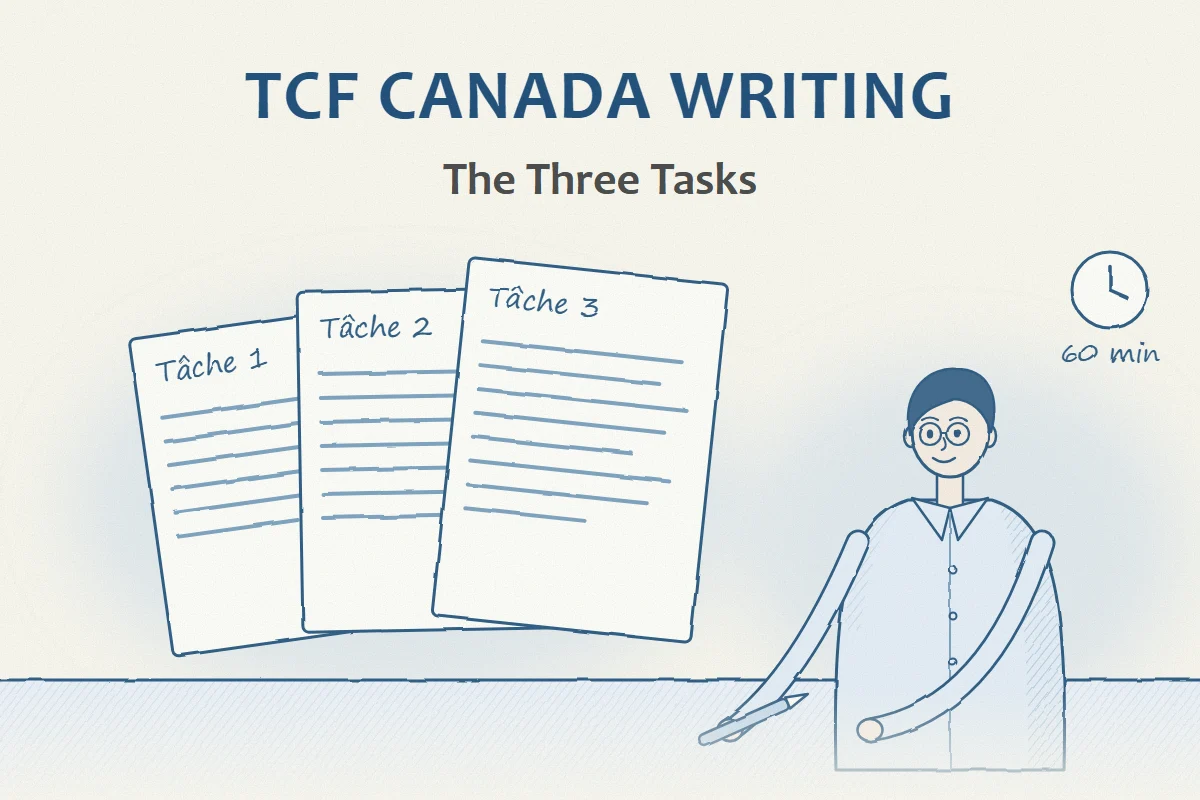
TCF Canada Writing (Expression écrite, or EE) is three tasks in 60 minutes: a message of 60 to 120 words, an account of an experience of 120 to 150 words, and a comparison of two opinions with your own view in 120 to 180 words. The tasks are done in order, with no time limit for each one, and the result is a mark out of 20 that IRCC converts to an NCLC level.
- Three tasks, 60 minutes in all, done in order.
- Word ranges: 60–120, 120–150 and 120–180.
- A word is anything between two spaces.
- Outside the range, a task can be rated "A1 non atteint".
- NCLC 7 starts at 10 out of 20.
What are the three tasks?
| Task | What you write | Words |
|---|---|---|
| 1 | A message to one or more people, to describe, narrate or explain | 60–120 |
| 2 | An article, letter or note for several readers, giving an account of an experience or event with comments, opinions or arguments | 120–150 |
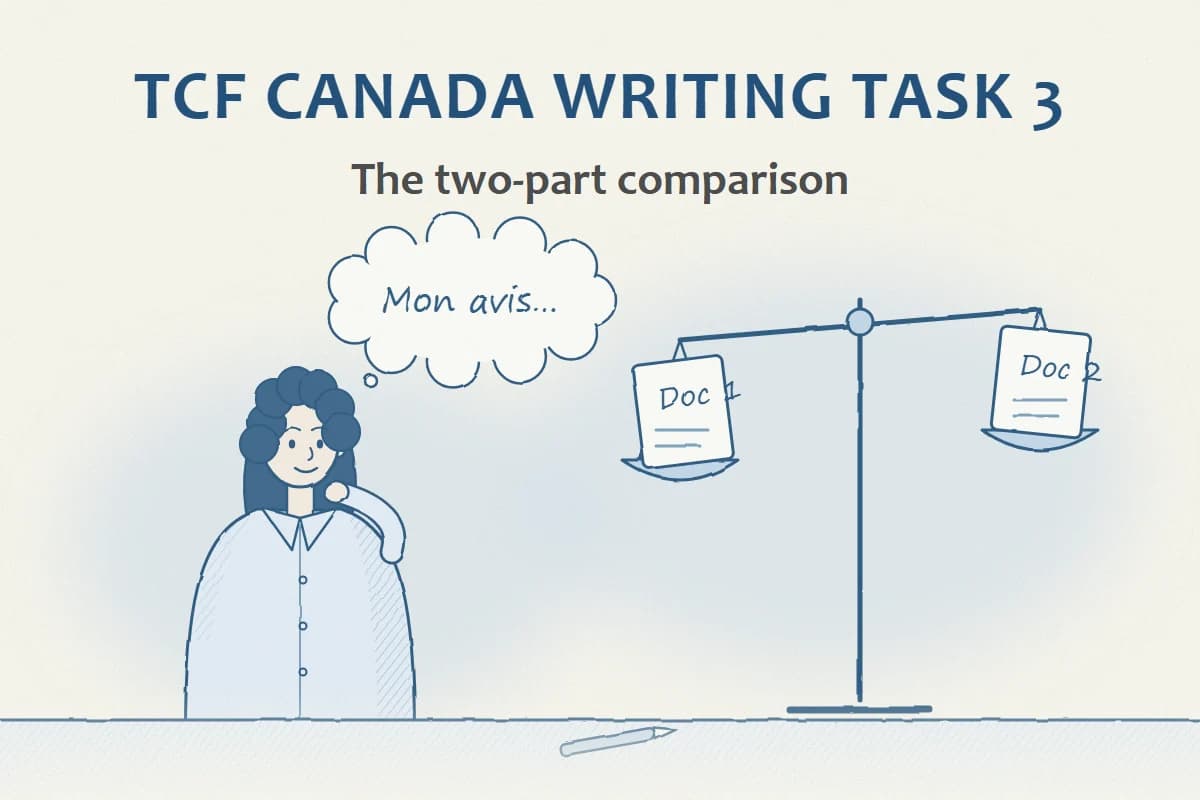
| 3 | A text comparing two points of view on a social issue, given in two short documents, followed by your own opinion | 120–180 |
You have 60 minutes for all three, with no time set for each task. Start with Task 1, then Task 2, then Task 3. Task 3 is the longest and hardest, so keep enough time for it.
How does French count words?
FEI's rule is simple: a word is any group of characters between two spaces. "Un bon sujet" is 3 words. "C'est-à-dire" is 1 word, and so are "c'est", "aujourd'hui" and "peut-être". Count your words for every task, because the range matters.
Writing outside the range has no fixed deduction, but FEI says the task could be rated "A1 non atteint" (below A1). The same risk applies to a missing task, an off-topic answer, sentences copied from the subject, or a text learned by heart.
How should you write Task 1?
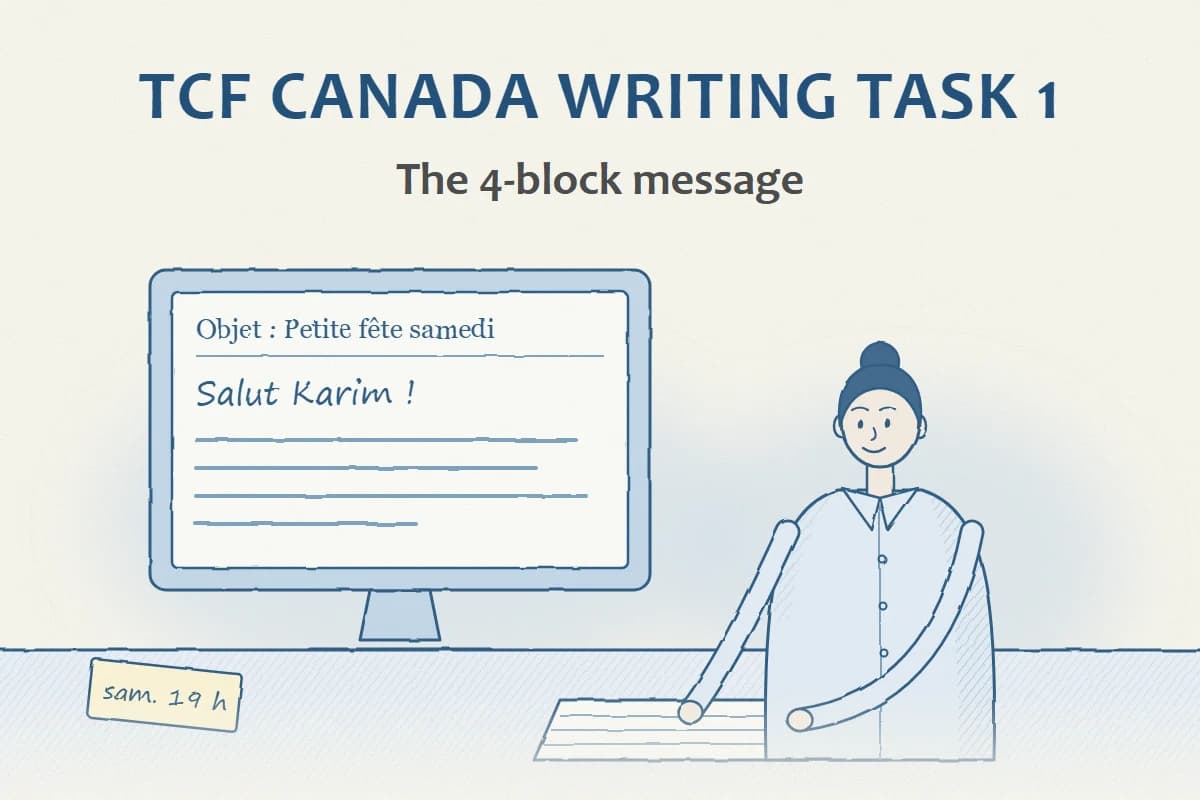
Task 1 is a short, practical message, such as an invitation, a reply or a request. Answer every point in the instructions, use the right register (tu for a friend, vous for someone you don't know) and open and close the message properly. Here is an example subject written by Exam Hero, with a model answer of about 90 words:
Vous venez d’emménager dans un nouvel appartement. Écrivez un message à un ami pour l’inviter à une petite fête. Donnez la date et l’heure, et expliquez comment venir. (60 mots minimum, 120 mots maximum)
Salut Karim,
J’espère que tu vas bien ! Comme tu le sais, j’ai enfin emménagé dans mon nouvel appartement à Gatineau. Pour fêter ça, j’organise une petite soirée le samedi 14 juin à partir de 19 h. Il y aura quelques amis du travail et mes voisins. Tu n’as rien à apporter, mais si tu veux, tu peux venir avec un dessert. Pour venir, prends le bus 33 et descends à l’arrêt Laurier : l’immeuble est juste en face. Dis-moi avant jeudi si tu peux venir.
À samedi, j’espère !
Lucie
Why it works: it answers all three points (the date and time, the invitation, how to get there), stays well inside the range, uses tu throughout and links ideas with simple connectors.
How should you structure Task 3?
Task 3 gives you two short documents with opposing views. Restate both views in your own words, then give and justify your own opinion. In FEI's published sample subject, the first part (both opinions) was 40 to 60 words and the second (your position) was 80 to 120. That split comes from one sample, not a general rule, but it's a useful guide: the larger share goes to your own argument.
Don't copy sentences from the documents. Rephrase them; copying can be rated "A1 non atteint".
How is Writing marked?
Two raters mark your writing. On computer, an automated aid may do the first marking, but the second is always human. Each task gets a CEFR level, and FEI combines the levels into a mark out of 20 with a formula it doesn't publish. The criteria are published:
- Linguistic: range of vocabulary, grammatical accuracy, spelling, sentence complexity.
- Pragmatic: coherence and cohesion, thematic development.
- Sociolinguistic: fit to the situation (register, format, reader).
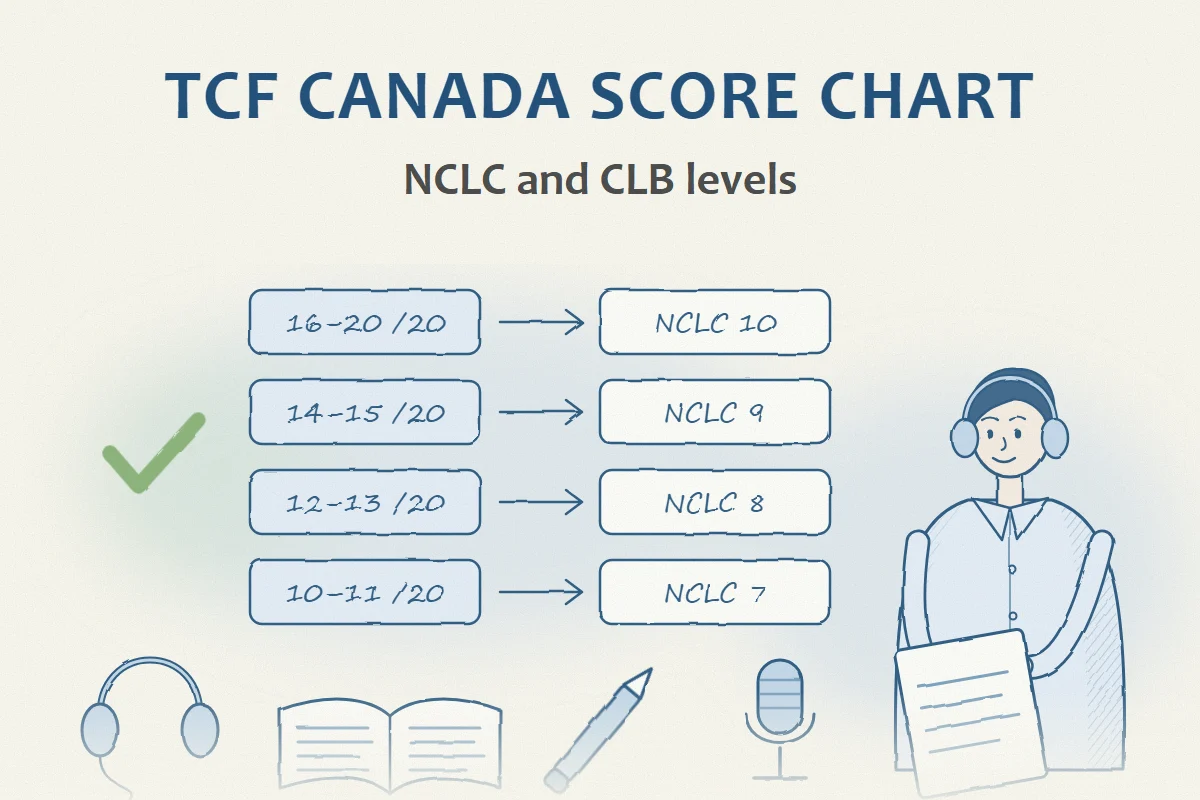
| NCLC | Writing mark |
|---|---|
| 10 and above | 16–20 |
| 9 | 14–15 |
| 8 | 12–13 |
| 7 | 10–11 |
| 6 | 7–9 |
| 5 | 6 |
| 4 | 4–5 |
Check IRCC's website for the current table.
What mistakes cost the most marks?
- Running out of time for Task 3. It's the longest task and the one where you show the most.
- Missing a point in the instructions. Tick off every point before you move on.
- Using memorised texts. Raters spot them, and they can be rated "A1 non atteint".
- Ignoring accents and agreement. Spelling is one of the criteria; leave a few minutes to reread.
Practise each task on its own in Exam Hero's question bank and get an estimated mark out of 20 with feedback on every criterion. Exam Hero is an independent preparation platform, not affiliated with FEI or IRCC, and its marks are estimates.