
TCF Canada Speaking
TCF Canada Speaking Task 1 Template: Guided interview
Who you are, what you do, your life here, your plans. The examiner asks about you for two minutes; with four topics ready, every answer is full and you never run dry.
2 minutes · no preparation · about 30 seconds a topic
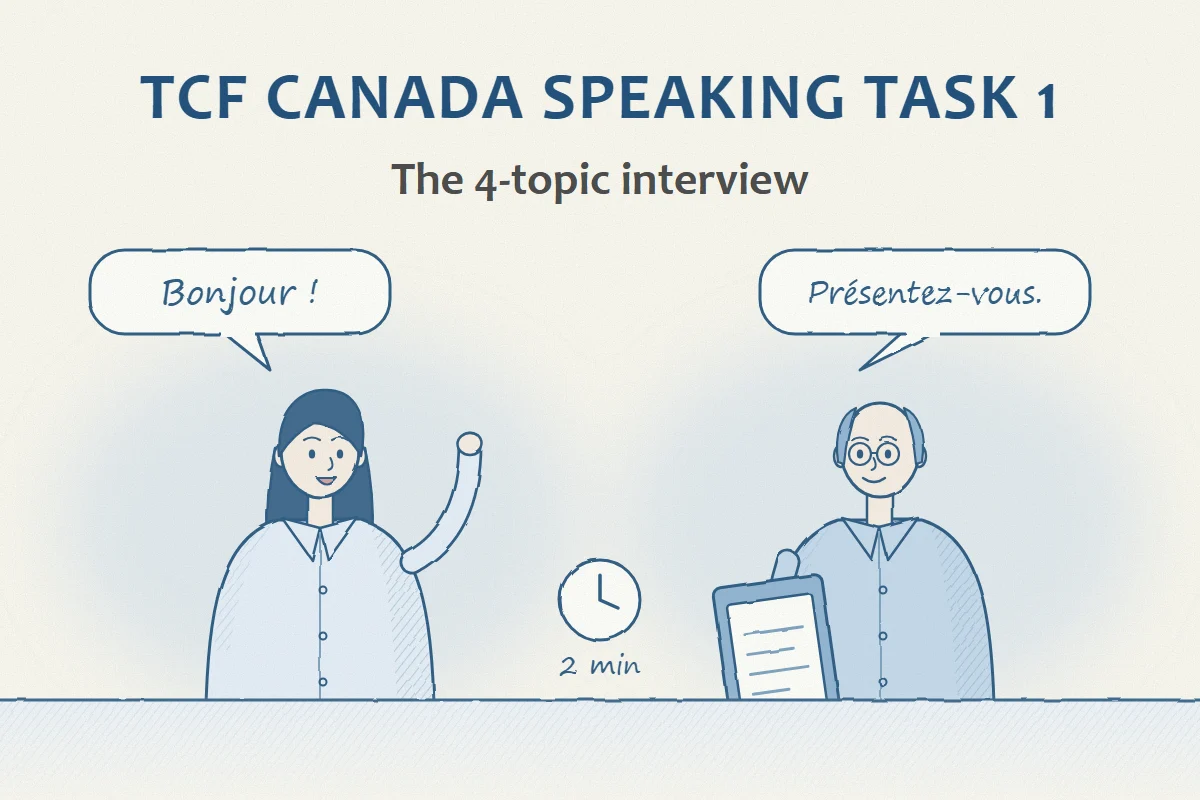
The 4-topic interview: remember it as
- Who I am
- What I do
- My life here
- My plans
When to use it: Task 1, with no preparation. Treat it as a first conversation with someone you've just met: use vous with the examiner, and answer each question with the answer, a detail and a reason.
The template
Each stage has a job and a time budget. Use the starters as springboards, not a script: a recited answer can be rated “A1 non atteint”.
- 1
Who I am
30 sYour name, where you're from, where you live and with whom.
Starters, in French
- Je m’appelle blank et je viens de blank.
- J’habite à blank depuis blank, avec blank.
Do
- Two or three facts, linked in full sentences
- A time marker: depuis deux ans, il y a trois mois
Avoid
- One-word answers: "Dakar."
- A recited paragraph: it can be rated "A1 non atteint"
Earns:Ease and fluencyFit to the situation
- 2
What I do
30 sYour job or studies, with one detail about what you like in it.
Starters, in French
- Je travaille comme blank dans blank.
- Ce qui me plaît dans mon travail, c’est blank.
Do
- What you do and for how long
- One opinion: ce qui me plaît, c'est…
Avoid
- Job titles in English with no explanation
- Complaining about your boss for a whole minute
Earns:Range of vocabularyThematic development
- 3
My life here
30 sYour free time and daily life, with an example.
Starters, in French
- Pendant mon temps libre, j’aime blank, parce que blank.
- Le week-end, je blank.
Do
- One activity and why you like it
- A concrete example: last weekend, every Sunday
Avoid
- A list of hobbies with no detail
- Waiting in silence for the next question
Earns:Thematic developmentInteraction
- 4
My plans
30 sWhat you hope to do next, and why French matters for it.
Starters, in French
- Dans quelques années, j’aimerais blank.
- Je passe le TCF parce que blank.
Do
- A future form: j'aimerais, je voudrais, je vais
- A reason linked to your plan
Avoid
- "I don't know" and nothing more
- Asking the examiner whether you passed
Earns:Grammatical accuracyEase and fluency
What to do, what to avoid
Do
- Full answers: the answer, a detail and a reason
- Vous with the examiner, from the first word
- Three time frames: present, past (depuis, il y a) and future
- Linking words: parce que, mais, donc, par exemple
Avoid
- A speech learned by heart: it can be rated "A1 non atteint" and treated as fraud
- Yes or no with nothing after it
- Long silences: say "Alors…" or "Voyons…" while you think
- Tu with the examiner
See it in action
A sample task and a model conversation, grouped by stage.
The task
L’examinateur vous pose des questions sur vous : votre vie, votre travail, vos loisirs, vos projets. (2 minutes, sans préparation)
- 1Who I am~30 s
Examiner
Bonjour. Pouvez-vous vous présenter ?
You
Bonjour ! Je m’appelle Amina et je viens de Dakar, au Sénégal. J’habite à Montréal depuis deux ans, dans le quartier Rosemont, avec mon mari et notre fille.
- 2What I do~30 s
Examiner
Qu’est-ce que vous faites dans la vie ?
You
Je travaille comme assistante dans une pharmacie. Ce qui me plaît, c’est le contact avec les clients : chaque jour, j’aide des gens différents.
- 3My life here~30 s
Examiner
Et quand vous ne travaillez pas ?
You
J’adore cuisiner. Le week-end dernier, par exemple, j’ai préparé un thiéboudiène pour mes voisins. Ils ont beaucoup aimé, donc je vais recommencer !
- 4My plans~30 s
Examiner
Quels sont vos projets ?
You
Dans quelques années, j’aimerais devenir technicienne en pharmacie. C’est pour ça que je passe le TCF : il me faut un bon niveau de français.
Why it scores: Every answer has the answer, a detail and a reason or example, so the examiner never has to pull. Amina uses the present, the past (j'ai préparé) and the future (j'aimerais, je vais), and keeps vous throughout.
Make it stick
Three quick rounds: put the stages in order, spot the line that scores, then practise the timing out loud.
Put the stages in order
Tap the part that comes first.
Say this, not that
1. Which scores higher?
2. Which scores higher?
3. Which scores higher?
4. Which scores higher?
Practise the timing
There is no preparation in this task. Press start and answer out loud: the bar shows which stage you should be on.
Press start: 2:00 to speak, no preparation
First up: Who I am
Je m’appelle blank et je viens de blank.
Mistakes that cost marks
- Short answers. Two minutes go fast, and every "oui" alone is a missed chance.
- Reciting a prepared self-introduction. Prepare topics and phrases, never a script.
- Speaking only in the present. Show the past and the future too.
- Switching to English when a word is missing. Describe it in French instead: "c'est un objet qui sert à…".
Free to try
Use this template on a real Speaking Task 1
Open a task in the question bank and talk with a live French examiner. The template sits beside the card and shows which stage you should be on, then you get an estimated mark out of 20.
Practise Speaking Task 1Keep going
Frequently asked questions
What does the examiner ask in Task 1?
Questions about you: where you live, your work or studies, your free time, your plans. It's a conversation with someone you don't know, so expect follow-ups on whatever you say.
Can I prepare my answers in advance?
Prepare the topics and the vocabulary, not the sentences. A memorised speech can be rated "A1 non atteint" and treated as fraud. Practise answering differently each time.
How long should each answer be?
Three or four sentences: the answer, a detail, a reason or an example. About 20 to 30 seconds, then let the examiner ask the next question.