
TCF Canada Speaking
TCF Canada Speaking Task 3 Template: Give and defend your opinion
Your position, two arguments with examples, an answer to the examiner's objection, and a conclusion. A clear plan keeps you talking for four and a half minutes, and handling the push-back is where the higher levels are.
4 min 30 · no preparation · the examiner may interrupt
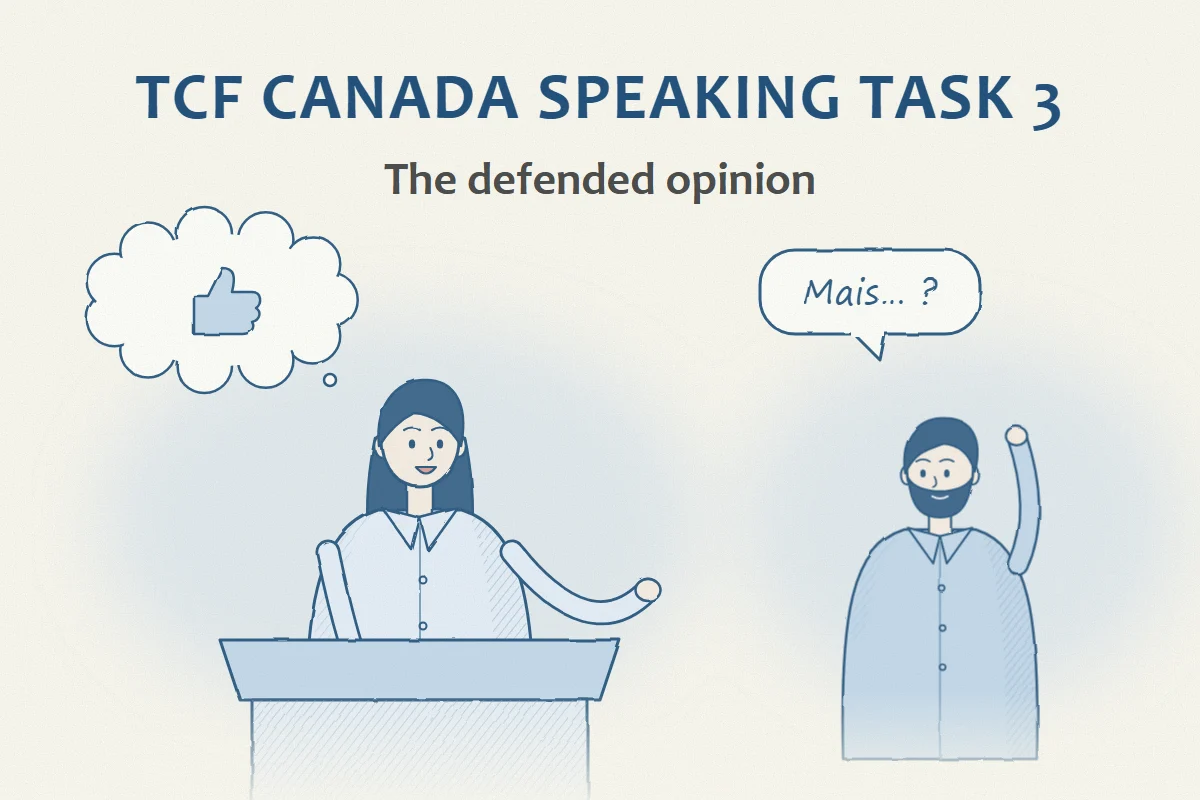
The defended opinion: remember it as
- Your position
- First argument
- Second argument
- Answer the push-back
- Conclusion
When to use it: Task 3, with no preparation: the examiner picks a question and you give your view. Take a few seconds to choose your side, then follow the plan. When the examiner interrupts, that's part of the task, not a problem.
The template
Each stage has a job and a time budget. Use the starters as springboards, not a script: a recited answer can be rated “A1 non atteint”.
- 1
Your position
30 sRephrase the question and say where you stand, in the first two sentences.
Starters, in French
- C’est une question importante, parce que blank.
- Pour ma part, je suis plutôt blank, mais blank.
Do
- The question rephrased in your own words
- A clear position, even if nuanced
Avoid
- "Je ne sais pas" as an opening
- A long introduction before your opinion
Earns:Thematic developmentCoherence and cohesion
- 2
First argument
1 min 10 sYour strongest reason, with an example you can describe.
Starters, in French
- D’abord, blank. Par exemple, blank.
- Je l’ai vu moi-même : blank.
Do
- A reason and a concrete example
- A first connector: d'abord, premièrement
Avoid
- Three reasons in three seconds
- Invented statistics
Earns:Thematic developmentRange of vocabulary
- 3
Second argument
1 min 10 sA second reason from another angle: society, cost, health, the future.
Starters, in French
- Ensuite, il ne faut pas oublier que blank.
- De plus, blank, ce qui blank.
Do
- A different angle from argument 1
- A complex sentence: ce qui, alors que, pour que
Avoid
- Repeating argument 1 in other words
- Drifting away from the question
Earns:Coherence and cohesionSentence building
- 4
Answer the push-back
1 min 10 sWhen the examiner objects, grant the point, then defend or nuance your view.
Starters, in French
- C’est vrai, je suis d’accord sur ce point. Cependant, blank.
- Je comprends l’argument, mais à mon avis blank.
Do
- An acknowledgement: c'est vrai, vous avez raison sur ce point
- Your position again, refined
Avoid
- Giving up your opinion at the first objection
- Ignoring the examiner's point and carrying on
Earns:InteractionEase and fluency
- 5
Conclusion
30 sSum up your position in one or two sentences.
Starters, in French
- En conclusion, je pense que blank.
- Pour résumer, blank, à condition que blank.
Do
- A closing connector and your position
- The nuance you added, if any
Avoid
- A new argument at the end
- Stopping mid-sentence when time runs out
Earns:Coherence and cohesionThematic development
What to do, what to avoid
Do
- A clear position in your first two sentences
- Two arguments from different angles, each with an example
- Connectors that show the plan: d'abord, ensuite, cependant, en conclusion
- A real answer to the examiner's objection
Avoid
- A prepared speech on a topic you hoped to get
- "Les deux ont raison" with no side
- Changing your opinion as soon as the examiner disagrees
- Long silences: buy time with "c'est une bonne question"
See it in action
A sample task and a model conversation, grouped by stage.
The task
À votre avis, faut-il interdire les téléphones portables à l’école ? (4 minutes 30, sans préparation)
- 1Your position~30 s
Examiner
À votre avis, faut-il interdire les téléphones portables à l’école ?
You
C’est une question importante, parce que presque tous les élèves ont un téléphone aujourd’hui. Pour ma part, je suis plutôt pour l’interdiction en classe, mais pas dans toute l’école.
- 2First argument~1 min 10 s
You
D’abord, le téléphone empêche de se concentrer. Je l’ai vu moi-même avec ma nièce : quand elle fait ses devoirs, elle vérifie ses messages toutes les cinq minutes. Résultat, un exercice de dix minutes lui prend une heure. En classe, c’est la même chose, et en plus, ça dérange les autres élèves.
- 3Second argument~1 min 10 s
You
Ensuite, il ne faut pas oublier les relations entre les jeunes. Pendant la récréation, beaucoup d’élèves restent seuls devant leur écran au lieu de parler ou de jouer ensemble, ce qui est dommage. L’école, c’est aussi l’endroit où on apprend à vivre avec les autres.
- 4Answer the push-back~1 min 10 s
Examiner
Mais les parents veulent pouvoir joindre leurs enfants en cas d’urgence, non ?
You
C’est vrai, je suis d’accord sur ce point. Cependant, les élèves peuvent garder leur téléphone éteint dans leur sac. En cas d’urgence, les parents peuvent aussi appeler le secrétariat de l’école, comme avant. C’est pour ça que je parle d’interdiction en classe, et pas d’interdiction totale.
- 5Conclusion~30 s
You
En conclusion, je pense qu’il faut interdire les téléphones en classe, mais laisser les élèves les utiliser pendant les pauses, avec des règles claires.
Why it scores: The position is clear in the first two sentences, each argument has its own angle and a real example, and the objection is granted then answered without dropping the view. Connectors (d'abord, ensuite, cependant, en conclusion) make the plan easy to follow.
Make it stick
Three quick rounds: put the stages in order, spot the line that scores, then practise the timing out loud.
Put the stages in order
Tap the part that comes first.
Say this, not that
1. Which scores higher?
2. Which scores higher?
3. Which scores higher?
4. Which scores higher?
Practise the timing
There is no preparation in this task. Press start and answer out loud: the bar shows which stage you should be on.
Press start: 4:30 to speak, no preparation
First up: Your position
C’est une question importante, parce que blank.
Mistakes that cost marks
- Giving up your opinion when the examiner disagrees. The objection is a test of how you defend it.
- Talking for one minute and stopping. Plan two arguments with examples so you can fill the time.
- Reciting a speech prepared for another topic. It can be rated "A1 non atteint" and treated as fraud.
- No connectors, so the examiner can't follow the plan.
Free to try
Use this template on a real Speaking Task 3
Open a task in the question bank and talk with a live French examiner. The template sits beside the card and shows which stage you should be on, then you get an estimated mark out of 20.
Practise Speaking Task 3Keep going
Frequently asked questions
What kind of questions come up in Task 3?
Social questions you can have an opinion on without special knowledge: phones at school, working from home, city or country life, tourism, the environment. The examiner picks the question.
Should I agree or disagree?
Either. There's no right side; pick the one you have the best examples for. A nuanced position ("yes, but…") is fine, as long as it's clear.
Why does the examiner interrupt me?
It's part of the task: FEI says the examiner may ask follow-up questions. They're testing how you react and defend your view. Acknowledge the point, then answer it.