
TCF Canada Speaking
TCF Canada Speaking Task 2 Template: Role-play
Open the call, ask the essential questions, then the detail ones, react to the answers and close. In Task 2 you ask the questions, and leading the conversation is what scores.
3 min 30 of dialogue · after 2 minutes to prepare · draft paper allowed
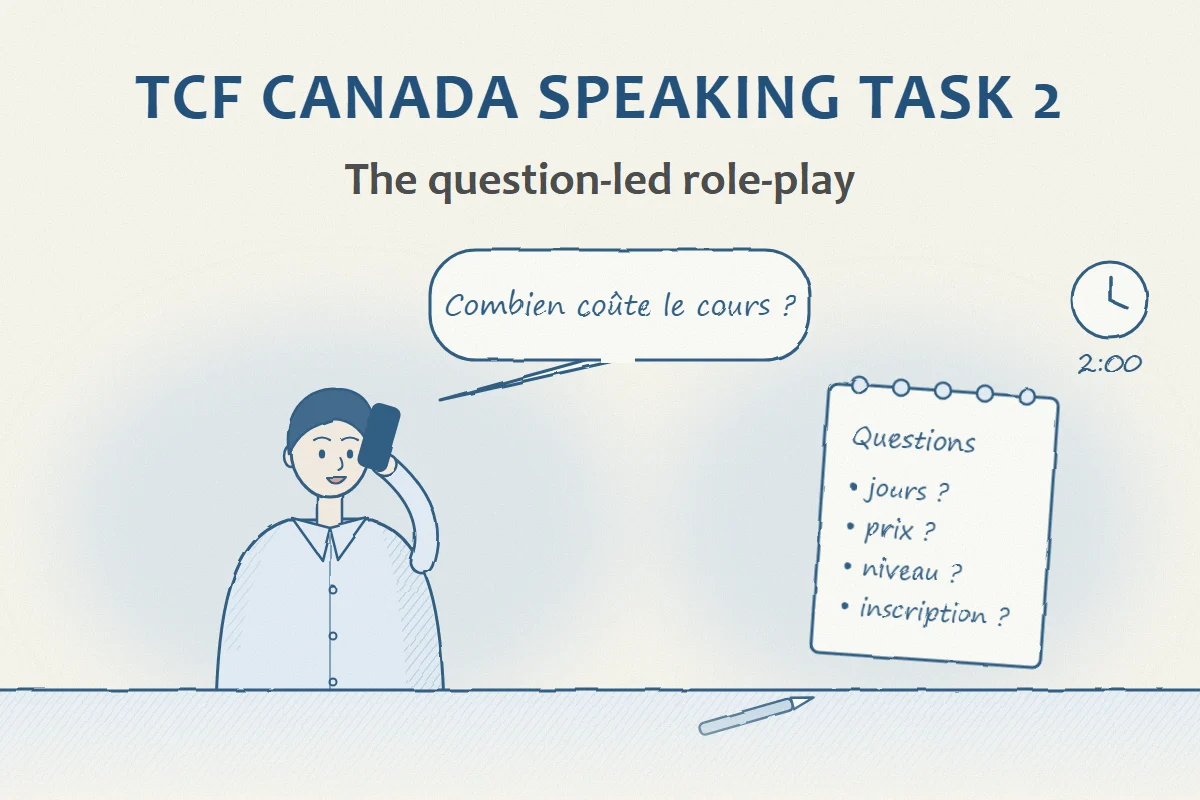
The question-led role-play: remember it as
- Open and explain
- Essential questions
- Detail questions
- React and decide
- Thank and close
When to use it: Task 2: an everyday situation where you need information, such as booking, enrolling or buying. Use the 2 minutes to write your questions, keep vous throughout, and remember the examiner only answers what you ask.
The template
Each stage has a job and a time budget. Use the starters as springboards, not a script: a recited answer can be rated “A1 non atteint”.
- 1
Open and explain
20 sGreet, say who you are and why you're calling, in two sentences.
Starters, in French
- Bonjour, je vous appelle au sujet de blank.
- Je voudrais quelques informations sur blank.
Do
- A polite greeting and the reason for the call
- Your first question straight away
Avoid
- Waiting for the examiner to speak first
- Telling your whole life before asking anything
Earns:Fit to the situationInteraction
- 2
Essential questions
1 min 10 sAsk what anyone would need to know: when, how much, where.
Starters, in French
- Les cours ont lieu quel jour, et à quelle heure ?
- Combien coûte blank, et est-ce que blank est compris ?
- Est-ce qu’il reste des places pour blank ?
Do
- Three question forms: est-ce que, inversion, question words
- A short reaction after each answer: d'accord, très bien
Avoid
- Asking every question with "est-ce que"
- Firing questions without listening to the answers
Earns:InteractionGrammatical accuracy
- 3
Detail questions
1 minGo further: conditions, level, what's included, what if.
Starters, in French
- Faut-il avoir un niveau particulier ?
- Et si je dois annuler, est-ce que je suis remboursé ?
- Vous voulez dire que blank ?
Do
- A follow-up built on what the examiner just said
- A conditional question: et si…, au cas où…
Avoid
- Running out of questions after a minute
- Questions the card has nothing to do with
Earns:InteractionThematic development
- 4
React and decide
40 sSum up what you heard, give your reaction, and decide.
Starters, in French
- Si je comprends bien, blank.
- Ça me convient parfaitement, parce que blank.
- Dans ce cas, je voudrais blank.
Do
- A reformulation: si je comprends bien…
- A decision or a next step
Avoid
- "OK" after every answer and nothing else
- Ending without saying what you'll do
Earns:InteractionCoherence and cohesion
- 5
Thank and close
20 sThank the examiner and close the call politely.
Starters, in French
- Merci beaucoup pour ces informations.
- Je vous souhaite une bonne journée. Au revoir !
Do
- Thanks and a goodbye in the polite register
- A last confirmation if there's time: "à jeudi, donc"
Avoid
- "Salut !" to an employee you don't know
- Stopping abruptly when you run out of questions
Earns:Fit to the situationInteraction
What to do, what to avoid
Do
- Six to eight questions, written during the 2 minutes
- Varied question forms: est-ce que, inversion, quel, combien, comment
- Reactions and follow-ups on the examiner's answers
- Vous and the conditional of politeness: je voudrais, pourriez-vous
Avoid
- Answering instead of asking: if the examiner talks most, the task isn't done
- Writing full sentences during preparation: note key words
- Reading your notes aloud word for word
- Tu with the examiner, even if the role is friendly
See it in action
A sample task and a model conversation, grouped by stage.
The task
Vous voulez vous inscrire à un cours de cuisine dans un centre communautaire. Vous appelez le centre pour obtenir des informations (jours, horaires, prix, niveau, inscription).
- 1Open and explain~20 s
You
Bonjour, je vous appelle au sujet de vos cours de cuisine. Est-ce qu’il reste des places pour la session d’automne ?
The centre's receptionist
Bonjour ! Oui, il reste encore quelques places.
- 2Essential questions~1 min 10 s
You
Très bien. Les cours ont lieu quel jour, et à quelle heure ?
The centre's receptionist
Le mardi soir, de 18 h 30 à 20 h 30, pendant dix semaines.
You
Le mardi soir, c’est parfait pour moi. Et combien coûte l’inscription ? Est-ce que le matériel est compris ?
The centre's receptionist
C’est 180 dollars pour la session, ingrédients compris. Il faut seulement apporter un tablier.
- 3Detail questions~1 min
You
D’accord. Faut-il avoir un niveau particulier, ou les débutants sont-ils acceptés ?
The centre's receptionist
Tout le monde est bienvenu, le cours est pour les débutants.
You
Tant mieux ! Et si je dois annuler, est-ce que je suis remboursé ?
The centre's receptionist
Oui, si vous annulez une semaine avant le premier cours.
- 4React and decide~40 s
You
Si je comprends bien, c’est 180 dollars, le mardi soir, et je peux annuler jusqu’à une semaine avant. Ça me convient. Comment est-ce que je peux m’inscrire : en ligne ou sur place ?
The centre's receptionist
Les deux sont possibles. En ligne, c’est sur notre site.
You
Alors je vais m’inscrire en ligne ce soir.
- 5Thank and close~20 s
You
Merci beaucoup pour ces informations. Bonne journée, au revoir !
The centre's receptionist
Merci à vous, au revoir !
Why it scores: The candidate leads from the first line, varies the question forms (est-ce que, quel jour, inversion), reacts to each answer before the next question, sums up with "si je comprends bien" and closes with a decision and a polite goodbye.
Make it stick
Three quick rounds: put the stages in order, spot the line that scores, then practise the timing out loud.
Put the stages in order
Tap the part that comes first.
Say this, not that
1. Which scores higher?
2. Which scores higher?
3. Which scores higher?
4. Which scores higher?
Practise the timing
Read the card above, press start and answer out loud. You get the test’s 2 minutes to prepare, then the bar shows which stage you should be on.
Press start: 2:00 to prepare, then 3:30 to speak
First up: Open and explain
Bonjour, je vous appelle au sujet de blank.
Mistakes that cost marks
- Letting the examiner lead. In Task 2 you ask; silence on your side means the task isn't done.
- Preparing three questions and running dry after a minute. Prepare six to eight.
- Asking without listening, so a question repeats something already answered.
- Dropping vous halfway through when the conversation warms up.
Free to try
Use this template on a real Speaking Task 2
Open a task in the question bank and talk with a live French examiner. The template sits beside the card and shows which stage you should be on, then you get an estimated mark out of 20.
Practise Speaking Task 2Keep going
Frequently asked questions
What should I write during the 2 minutes of preparation?
Key words for six to eight questions, grouped by topic: dates and times, price, conditions, how to sign up. Draft paper is allowed. Don't write full sentences; you won't have time, and reading them aloud sounds recited.
Who plays which role in Task 2?
The instructions set the roles. Usually you are the customer or the newcomer who needs information, and the examiner is the employee, the neighbour or the organiser who has it.
What if I run out of questions?
Reformulate what you've heard ("si je comprends bien…"), ask a what-if question ("et si je dois annuler ?"), or ask the examiner to explain something they said. Then decide and close politely.