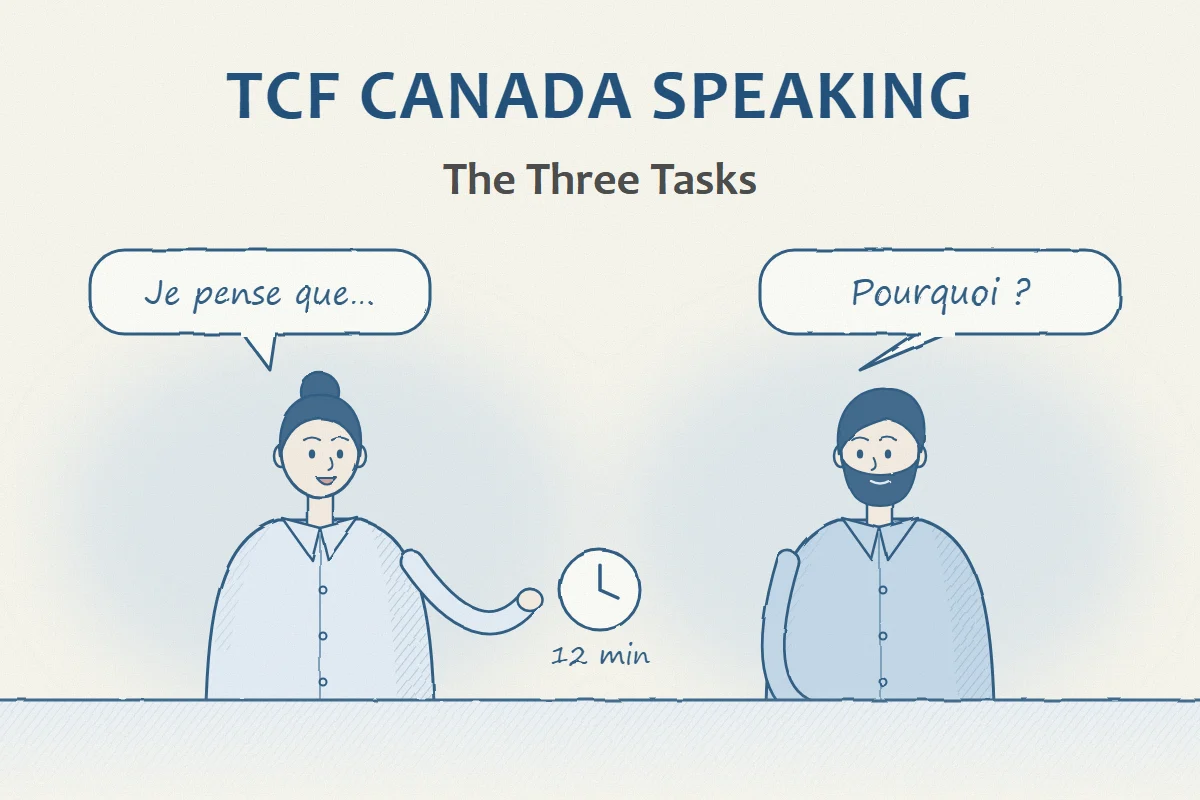
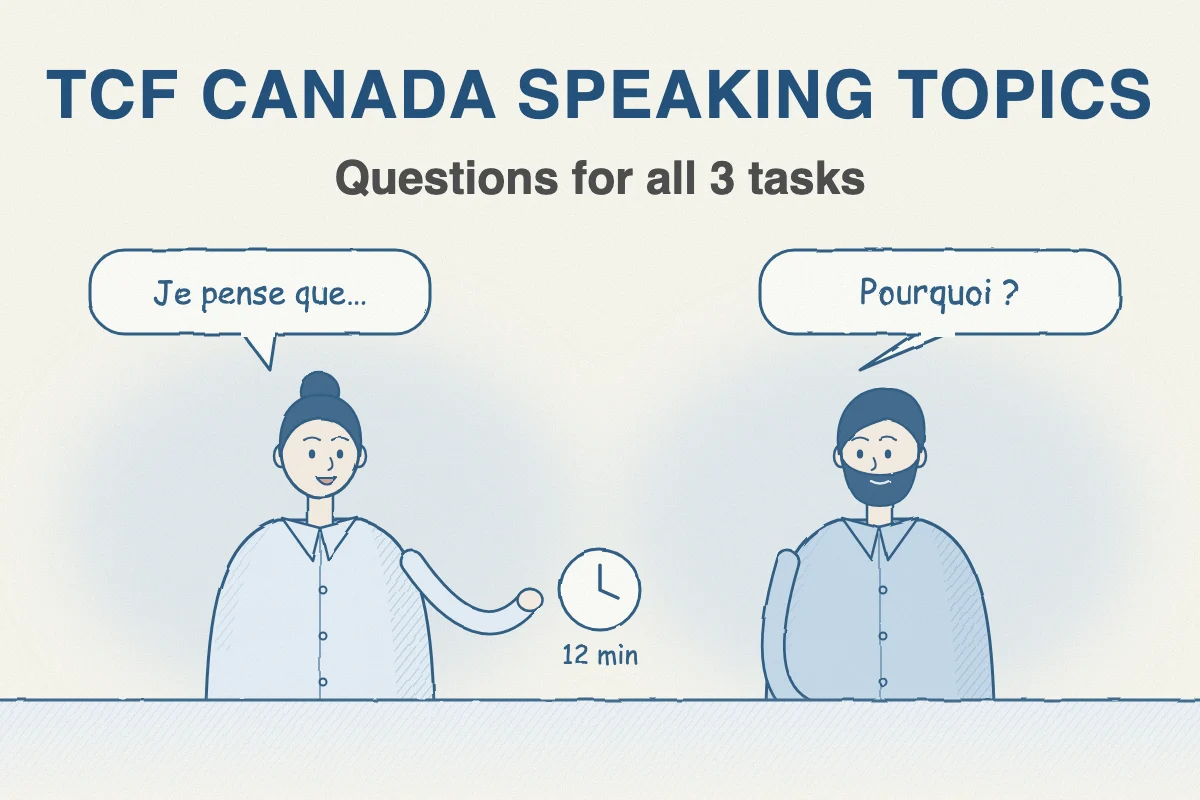
TCF Canada speaking topics follow the three tasks of the test: Task 1 asks about you (your life, work, family, free time and plans), Task 2 puts you in an everyday situation where you ask for information (renting, enrolling, booking, buying), and Task 3 asks your opinion on a social issue (work, technology, the environment, education, health, life in Canada). FEI doesn't publish its subjects, so the questions below are Exam Hero's own examples, written to match each task. Practise them on the real clock: 2 minutes, then 2 minutes of preparation and 3 minutes 30, then 4 minutes 30.
- Task 1: questions about you. Have four or five topics ready.
- Task 2: you ask the questions. Practise one scenario a day.
- Task 3: one opinion question, defended for 4 minutes 30.
- Prepare ideas and phrases by theme, never a script.
- Always practise with a timer and record yourself.
What questions come up in Task 1?
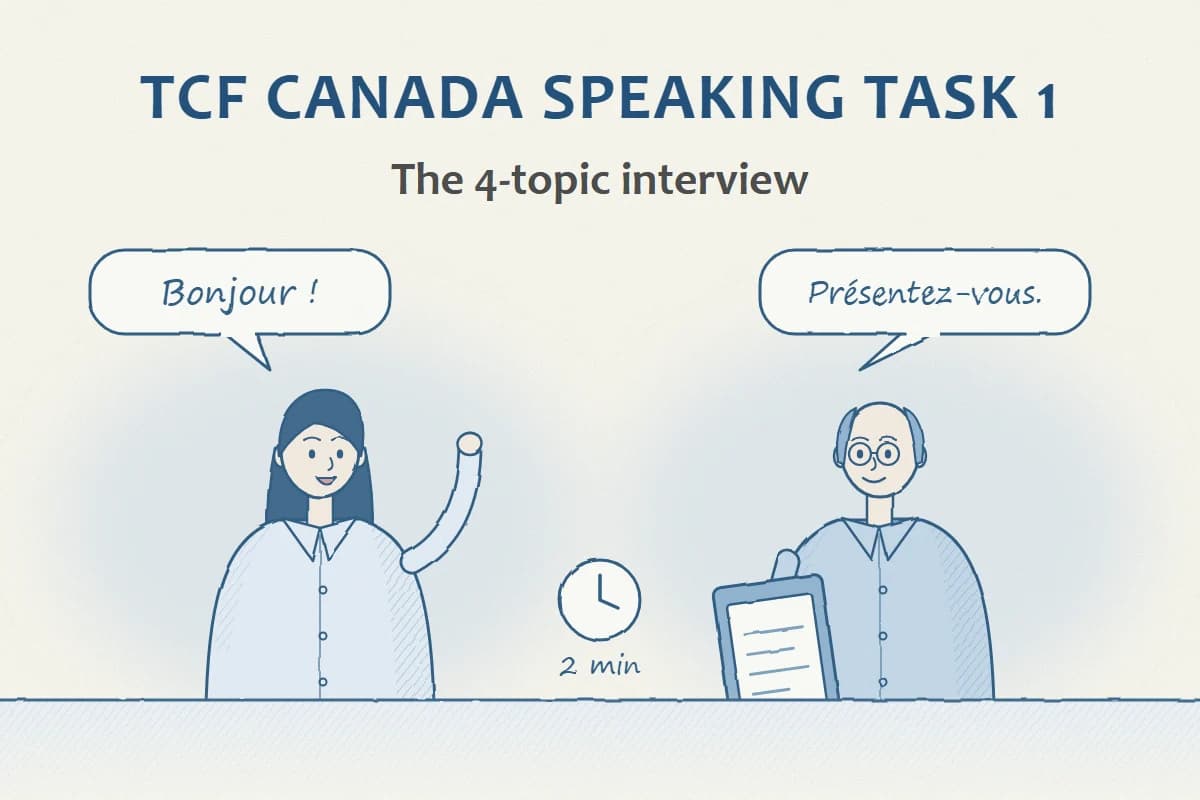
Task 1 is a 2-minute guided interview with no preparation. The examiner, someone you don't know, asks about you, and the topics are predictable: who you are, where you live, your family, your job or studies, your free time and your plans. These are the kinds of questions to expect:
- Pouvez-vous vous présenter ?
- D’où venez-vous, et depuis quand habitez-vous ici ?
- Avec qui vivez-vous ? Parlez-moi de votre famille.
- Que faites-vous dans la vie ? Qu’est-ce qui vous plaît dans votre travail ?
- Quelles études avez-vous faites ?
- Comment est le quartier ou la ville où vous habitez ?
- Que faites-vous pendant votre temps libre ?
- Pourquoi apprenez-vous le français ?
- Pourquoi avez-vous choisi le Canada ?
- Quels sont vos projets pour les prochaines années ?
Answer each one with the answer, a detail and a reason, so you speak more than the examiner. The Task 1 template splits the 2 minutes into four topics of about 30 seconds each.
What role-play scenarios come up in Task 2?
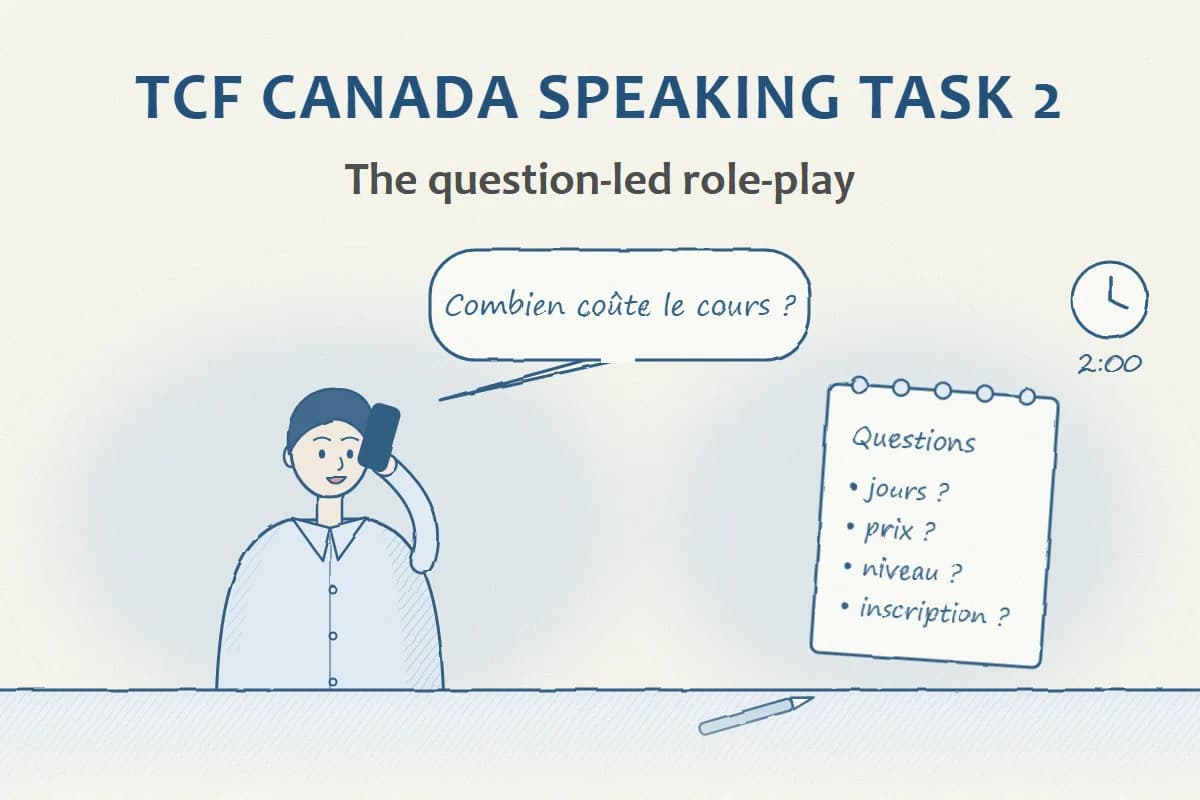
Task 2 is an everyday situation where you need information. You get 2 minutes to prepare, then 3 minutes 30 of conversation. The card sets the roles, the examiner plays the other person, and you ask the questions. Here are ten scenarios of that kind, with the role the examiner would play and what you would ask about:
| Situation | Rôle de l’examinateur | Ce que vous demandez |
|---|---|---|
| Vous cherchez un appartement à louer et vous appelez au sujet d’une annonce. | Le propriétaire | Loyer, charges, date d’entrée, quartier, animaux, visite |
| Vous voulez vous inscrire dans une salle de sport près de chez vous. | L’employé de l’accueil | Formules, prix, horaires, cours collectifs, engagement, essai gratuit |
| Vous voulez suivre un cours de français le soir. | Le responsable du centre de langues | Niveaux, test de placement, dates, prix, taille des groupes, certificat |
| Vous organisez une fête d’anniversaire dans un restaurant. | Le gérant du restaurant | Salle, nombre de places, menu, prix par personne, acompte, annulation |
| Vous voulez faire du bénévolat dans une association de votre quartier. | La coordinatrice des bénévoles | Missions, horaires, durée de l’engagement, formation, conditions |
| Vous cherchez une garderie pour votre enfant. | La directrice de la garderie | Places, âge, horaires, repas, tarifs, liste d’attente, inscription |
| Vous préparez un voyage d’une semaine et vous allez dans une agence. | L’agent de voyages | Destinations, prix, transport, hébergement, activités, assurance |
| Vous voulez acheter un vélo d’occasion vu sur un site d’annonces. | Le vendeur | État, âge, prix, accessoires, essai, paiement, livraison |
| Vous voulez changer de forfait de téléphone. | Le conseiller en boutique | Forfaits, données, appels à l’étranger, durée du contrat, frais |
| Vous cherchez un emploi d’été et vous appelez au sujet d’une offre. | Le responsable du recrutement | Tâches, horaires, salaire, dates, expérience demandée, candidature |
Most cards come down to the same checklist: price, dates and times, conditions, what's included, and how to sign up or pay. Learn those question forms once and they work for any scenario. The Task 2 template shows how to use the 2 minutes and lead the conversation, and the speaking guide has a full example with questions.
What opinion topics come up in Task 3?
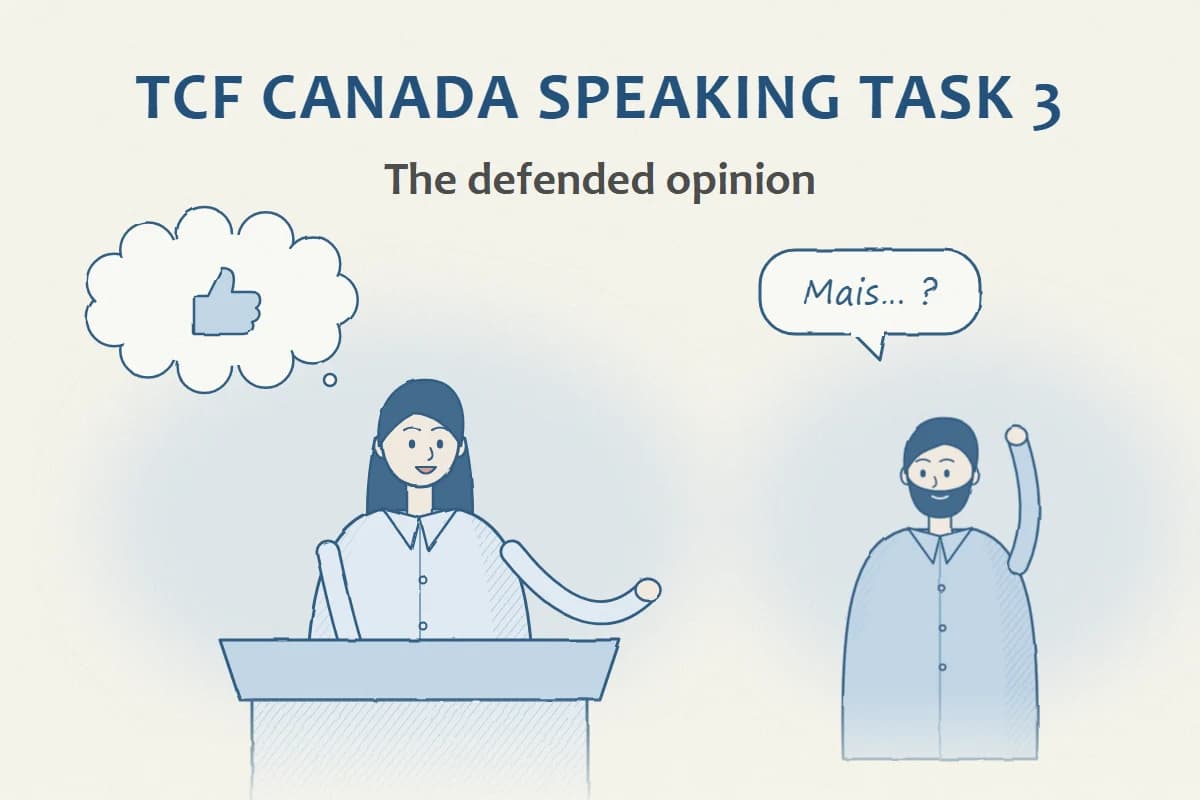
In Task 3 the examiner picks a question and you give your opinion and defend it for 4 minutes 30, with no preparation. The examiner may interrupt with a counter-argument. The questions are about everyday social issues, and they tend to fall into a few themes:
| Thème | Exemples de questions |
|---|---|
| Travail | Le télétravail est-il une bonne chose pour les employés ? · Faut-il réduire la semaine de travail à quatre jours ? |
| Technologie et réseaux sociaux | Les réseaux sociais rapprochent-ils ou isolent-ils les gens ? · Faut-il interdire le téléphone portable à l’école ? |
| Environnement | Les gestes individuels peuvent-ils vraiment protéger l’environnement ? · Faut-il rendre les transports en commun gratuits ? |
| Éducation | Les études universitaires devraient-elles être gratuites ? · L’école prépare-t-elle bien les jeunes au monde du travail ? |
| Santé | L’État doit-il taxer davantage les produits mauvais pour la santé ? · Le sport devrait-il être obligatoire pour les adultes au travail ? |
| Immigration et vie au Canada | Apprendre la langue du pays est-il le meilleur moyen de s’intégrer ? · Vaut-il mieux s’installer dans une grande ville ou une petite ville ? |
| Consommation | Achetons-nous trop de choses dont nous n’avons pas besoin ? · Le commerce en ligne est-il une menace pour les petits commerces ? |
| Famille et société | Les grands-parents ont-ils encore un rôle important dans la famille ? · Les jeunes devraient-ils quitter le domicile familial plus tôt ? |
| Culture et loisirs | Le tourisme de masse fait-il plus de mal que de bien ? · Les musées devraient-ils être gratuits pour tous ? |
For each theme, prepare two arguments on each side and one example from your own life or from Canada. That way you can take a position on any question in the theme and still answer the counter-argument. The Task 3 template gives the structure: opinion, reasons with examples, an answer to the objection, conclusion.
How should you practise these topics with a timer?
Speaking is marked on fluency and interaction as well as language, so practising out loud on the real clock matters more than reading lists. A simple routine:
- Task 1, 2 minutes. Pick three questions from the list at random and answer them without stopping. Record yourself, and check that each answer had a detail and a reason.
- Task 2, 2 + 3 minutes 30. Pick a scenario, set a 2-minute timer and write your questions as key words, not sentences. Then run 3 minutes 30 with a partner playing the examiner, or answer your own questions aloud.
- Task 3, 4 minutes 30. Pick a question you haven't seen, state your opinion in the first sentence and keep talking until the timer stops. Halfway through, argue against yourself and answer the objection.
- Listen back. Note the words you were missing and the mistakes you repeated, and work on those before the next session.
Rotate the themes so you don't practise only the topics you like. Two or three short sessions a week, all three tasks each time, build more fluency than one long session.
You can practise every task on its real clock with Exam Hero's live French examiner in the question bank, and take the full Speaking test in a TCF Canada practice test, with an estimated mark out of 20 and feedback on each criterion. Exam Hero is an independent preparation platform, not affiliated with FEI or IRCC, and its marks are estimates.